Monday, January 11, 2021
Armies assembled - Gita rendered by Krishna (Part 18: Mahabharata date)
6a. Lunar Margashira month Continued:
The Pandava troops left Upaplavya for Kurukshetra on the Pushya day of Margashira under the advice of Krishna.
- The next event given in Mahabharata was that the two sides assembled on the Magha day.[1] This means the Pandava army reached Kurukshetra by the third day.
- There is no information on when the Kaurava troops started from Hastinapur. The first occasion of Kartika Pushya when Bhishma was formally made the chief ended up with chaos with the cometry fragments causing inauspicious nimittas.
- The second occasion was Jyeshtha Amawasya which didn’t materialize at all. Perhaps Indra was worshiped on Jyeshtha day but movement of troops could have started on Margashira Pushya, given the fact that Pushya was a much sought after day.
- We can say for sure that the war did not start on Magha day due to the main reason that Krishna Chaturdasi, the day when Vyasa noticed a shower of flesh and blood was yet to occur.[2]
- There was no Krishna Chaturdasi in Kartika month. The Krishna Chaturdasi of Margashira was yet to happen when the Moon was in Magha star. So the verse on Magha could not have meant the commencement of the war but only war-preparedness.
Corroborating the planetary positions on the Magha day
- The verse states the position of the planets offering a good opportunity to crosscheck the date we arrived.
maghā viṣayagaḥ somas tad dinaṃ pratyapadyata
dīpyamānāś ca saṃpetur divi sapta mahāgrahāḥ (6-17-2)
(Translation by Ganguli: On that day on which the battle commenced Soma approached the region of Pitris. The seven large planets, as they appeared in the firmament, all looked blazing like fire)
The region of Pitris in the translation refers to the Nakshatra devata of the star Magha. Seven planets were in the sky blazing like fire.
To know how the Magha day looked, let me simulate it from the software based on Surya Siddhanta ayanamsa. The alignment for three features, the year Krodhi, Margashira and Magha star for New Delhi (the closest to Kurukshetra) is shown in Figure 1.
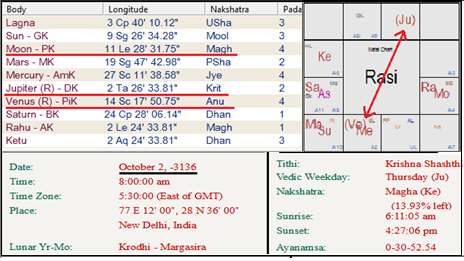
Fig 1: The day of Magha when Pandava- Kaurava army assembled in the war zone
The moon was in Magha at sunrise. Counting from the position of the sun at the 10th degree in Sagittarius (boxed horoscopy chart in Fig 1) in clockwise direction, six signs are in the day sky. In this section Mars, Saturn, Ketu and Jupiter appear in front of the sun. Including the sun, these five planets were in the day sky.
Venus at the 15th degree Scorpio and Mercury at the 28th degree Scorpio were behind the sun and could be sighted just before sunrise. As the sun was progressing in the sky they were also in the sky behind the sun. By about one and a half hours before sunset (one sign crosses the sky in two hours; the location of these two planets coming within one sign of the sun, they were less than two hours distance from the sun) when Venus was close to the western sky (just before setting), it was followed by Mercury, then the sun, Mars, Saturn, Ketu and Jupiter from west to east.
This was possible because from the 15th degree Scorpio where Venus was located, Jupiter was within 180 degree span (half the hemispherical sky) at the 3rd degree of Taurus. This is marked by an arrow mark in Fig 1. Just before Venus was about set in the evening sky in the west, Jupiter had risen in the eastern sky when the sun was still in the west. In this space-time position it can be said that seven planets including the sun were ‘burning’ in the sky due to day time sky.
· The specific reference to the burning of the sevens planets comes on a day that was exactly a month after the comet hit. Krishna Shashti (waning Shashti) was the tithi of the day. In the same tithi of the waning phase in Kartika, dreadful events were witnessed. Perhaps to indicate this, Sanjaya stated “somas tad dinaṃ pratyapadyata” where “pratyapadyata” means “returned” (Ref: SB 10.14.41, SB 4.12.9, SB 4.20.37, SB 7.10.6)
· Ganguli’s translation that the “battle commenced” is not correct. What is stated is that “the moon returned for the ‘viṣaya’ of Magha” Magha’s star lord is Pitr (पितृ), to whose domain the departed ones are said to ascend. The last time the moon came to the same tithi (in Kartika month), there was widespread death. Now it had come to the same tithi (Krishna Shashti) in the next month, in the star that signifies the domain of the departed ancestors. This causes the fear factor that gets further amplified by the presence of seven planets burning in the day sky. A perfect corroboration of the comet-fall on the same tithi in the previous month before sunset!
· Ganguli could not get this meaning. Even Nilakanta, the commentator of Mahabharata interpreted that “maghā viṣaya” referred to the dying soldiers getting the celestial body immediately without delay.[3]
· But having known the havoc caused by the cosmic collision, we are able to understand that the meaning of the verse is not what has been told. It is about the same tithi appearing with seven burning planets in the day sky towards sunset, reminding them of the burning sky a month ago. Sanjaya was anguished that the moon returned to the same tithi but in a star that also reminds one of death – of Pitru loka.
This verse provides an excellent corroboration for the comet-hit on Krishna Shashti in Kartika, the previous month!
Two Suns appeared one above the other.
Following the verse on seven planets at sunset time, Sanjaya continues to state the appearance of the sun at sunrise in the next verse.
dvidhā bhūta ivāditya udaye pratyadṛśyata
jvalantyā śikhayā bhūyo bhānumān udito divi (6-17-3)
Ganguli translates that the Sun at rising seemed to be divided in twain and appeared to be ablaze.[4] The verse further qualifies the appearance of the sun as having flame on its head (jvalantyā śikhayā). So the Sun appeared at the time of rise, with another flaming sun on its head. This has a scientific explanation of apparent image of the sun appearing above the actual sun caused by atmospheric refraction.
Under normal conditions, the rising or the setting sun is said to be an apparent image of the actual sun caused by atmospheric refraction. At sunrise even before the sun crosses the horizon, its rays are bent as they enter the earth’s atmosphere. The observer on the ground sees the image of the sun through the bent rays even though the sun is still under the horizon. (Figure 2) The same is repeated at sunset. Even after the sun had gone below the horizon, its rays reaching the atmosphere above the ground are refracted to the ground causing it to appear above the horizon.
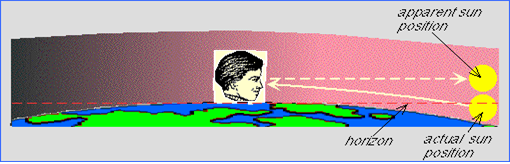
Fig 2: Sun appears before it rises above the horizon at sunrise
(Source: https://www.esrl.noaa.gov/gmd/grad/solcalc/apparent_sunrise.gif)
The Mahabharata verse hints at an extraordinary atmospheric condition when the light rays from the rising sun above the horizon, i.e. at the eye level was caused to deflect upwards and then downwards towards the ground. In the above figure, imagine the apparent sun as the actual sun above the horizon. Under standard conditions the sun light must have crossed the ground- level atmospheric layer of somewhat uniform density. If variations were there in the same layer, there is a likelihood of the rays getting deflected up and on encountering a differential density get refracted down. In such conditions, another sun appears above the actual sun at the horizon.
Similar appearance of the sun, on top of the sun was noticed at sunset in Zimbabwe on December 11, 2015. (Figure 3) [5]
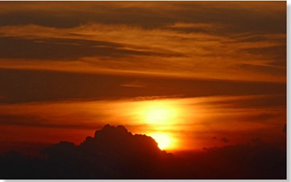
Fig 3: Two suns appearing one above the other.
Here the apparent sun is seen above the actual sun at the horizon. This ideally suits the description of Mahabharata verse that the sun appeared as two with the second one appearing ablaze. The only difference is that the above appearance happened at sunset while Mahabharata reports it at sunrise. The second image above the sun in both events can only be an apparent image, described as an image of flames of the sun on its head.
In the case of the above image, no scientific study is reported on this phenomenon except a generalized explanation that it is an optical illusion caused by an unusual atmospheric refraction. The place was reeling under drought and dryness when this appeared. This is in line with my explanation given in Part 14 on changed refractive index causing the deflection of Arundhati star, Mars and Dhruva to the right. In Mahabharata times, a similar phenomenon due to an after-effect of the comet-hit had caused the sun appear as two, one above the other at sun rise.
· The next and the last event in this month was the shower of flesh and blood on Krishna Chaturdasi day that appears in Vyasa’s version to Dhritarashtra.[6] The fortnight that started on Rohini (Krishna pratipat) ended in Jyeshtha Amawasya! What was supposed to be Amawasya day in the previous month of Kartika – that many researchers identified as the date of the commencement of the Mahabharata war – had appeared only a month later, on the last day of Margashira when the Sun was in Scorpio!
This is in perfect alignment with the movement of the sun that joins the moon in every 3rd star in its transit path. In the month of Kartika it joined the moon (in its 13 day phase) in Vishakha. Following the normal course, the next conjunction happened in Jyeshtha, but the month turned out to be Margashira! One month was lost due to the anomaly in the Moon’s orbit following the comet-hit. Amawasya of Margashira occurred in the same location of the zodiac where Amawasya of Kartika month must have occurred.
The Pushya month started the next day. Until then the war had not started, is the revelation we get from this systematic sequencing of the events of Mahabharata based on the Panchanga factors given in the text.
7. Lunar Pushya Month (Sun in Sagittarius)
- There are no Panchanga based clues in the text of Mahabharata for the start of the Mahabharata war; however it is being traditionally held that Krishna rendered his ‘Gita’ (Gitopadesa) to Arjuna on Shukla Ekadasi in Margashira on the day before the start of the Mahabharata war. By this it is known that the war started on Shukla Dwadasi of Margashira.
- The western approach coupled with the western concept of the astronomy simulator would not yield any evidence for the true date. Instead the approach should be to test the traditional belief (date of Gitopadesa) and find out whether it fits with the overall time scale derived from other astronomy observations. We will establish this in the following passages.
Deciphering the day of Gitopadesa
The derivation done so far revealed that there was no scope for the war in the lunar month of Margashira. The fact that (1) Balarama’s 42 day pilgrimage ended in the star of Shravana in Pushya month and (2) Krishna Caturdasi that witnessed the shower of flesh and blood occurred on the last day of the lunar Margashira goes to prove that the war did not start anytime in the lunar Margashira month. This implies that the month of Gitopadesa was solar Margashira and not lunar Margashira. The present practice of celebrating Gitopadesa day in the lunar Margashira month is therefore not correct. The mis-timing can be attributed to the loss knowledge of computation of time. Except Tamilnadu and a few other South Indian States, time keeping is not as it used to be in this country.
The sun which is the cause for Time is completely ignored in time computation. The Sun being the Pratyaksha Brahman is the source of all life. It is known as Ravi because it illuminates and protects all the three worlds.[7] The sun is also known as Kāla or Time from whom every other computation of time flows.[8] So the solar month cannot be left out in any reference to time.
Time must be calculated in four units, Saura (solar), Saumya (lunar), nakshatra (star) and Savana.[9] Therefore a day must be punctuated in terms of the solar month, the lunar paksha-tithi, the star of the day and the enumeration from sunrise (savana). When we understand this, we know that the Gitopadesa took place in solar Margashira month in Shukla paksha Ekadasi. The simulation for the year Krodhi (Figure 4) shows that the sun was in the last degree of Margashira (Sagittarius) while the lunar phase was that of Pushya Shukla Ekadasi at sunrise. The calendar date was 22nd October, 3136 BCE. The karana was not Vishti, but Bhadra in Shukla Ekadasi,
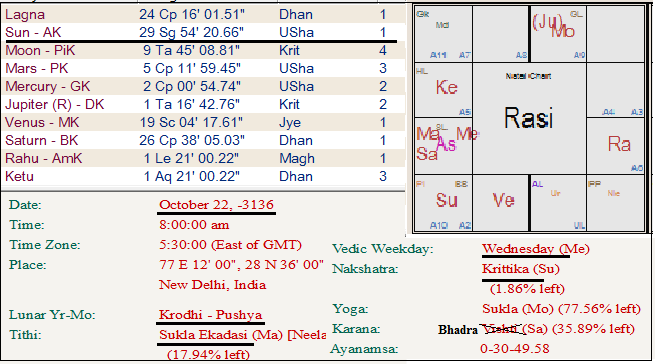
Fig 4: The date of Gitopadesa
The sun had not left Sagittarius at sunrise of Shukla Ekadasi when the lunar month of Pushya was running. The traditionalists have recognized the time as Margashira (the month expressed by the position of the sun) while Shukla Ekadasi (lunar) was running at sunrise (savana). The star of the day was Krittika at sunrise. The location of the two luminaries (the sun and the moon) is remembered as the day of “Vaikuntha Ekadasi” in the Tamil speaking lands, of entering Vaikuntha along with Vishnu. Though the memory of Gitopadesa given on this day is lost, the power of Krishna (Vishnu) in granting Vaikuntha to the devotee is associated with this day.
In contrast, the day of Gitopadesa is remembered in other parts of India, but not on the exact day fulfilling the requisites of Time. The solar month is completely ignored and the date is remembered only in the lunar reckoning which at times pushes the date to the solar month of Kartika that corresponds to the day before Krishna started the peace mission! Mis-representation like this must be corrected at the earliest.
The Gita is rendered by Krishna; the war is very near – the next day.
[1]Mahabharata: 6-17-2
[2] Mahabharata: 6-3-31
[4]Mahabharata: 6-17 http://www.sacred-texts.com/hin/m06/m06017.htm
[5]“Two Suns photographed in Zimbabwe during sunset” https://www.sott.net/article/308393-Two-suns-photographed-in-Zimbabwe-during-sunset
[6] Mahabharata: 6-3-31
[7] Brahmanda Purana: 21-4
[8] Brahmanda Purana: 23-145
[9] Vayu Purana: 1-50-188; Aryabhatiya: 3-5
Tuesday, January 12, 2021
The starting date of the Mahabharata war: 23rd October 3136 BCE. (Part 19: Mahabharata date)
The day the war started can be deduced from the Gitopadesa date (Margashira Shukla Ekadasi – 22nd October, 3136 BCE). That date must fulfill the astronomy features of the text. The simulated version of the day for Surya Siddhanta ayanamsa is given in Figure 1.

Fig 1: The starting date of the Mahabharata War (SS ayanamsa)
The war started on the first day of the solar month of Pushya (Makara) in lunar Pushya Shukla Dwadasi. The day corresponds to 23rd October, 3136 BCE. It was a Thursday with the moon at the last degree of Rohini at sunrise. It was followed by Mrigashirsha continuing on the night of the 1st day of the war. Counting from Mrigashirsha, Shravana started on the night of the 18th day of the war and ended on the 19th day when the Gada Yuddha was fought. Balarama returned from his pilgrimage on that day.
Corroboration of the astronomy features for the first day of the war.
Vyasa’s conversation with Dhritarashtra contains 78 nimittas in two chapters of Bhishma Parva in the nature of hints on the astronomy features of the day of the war or just before the war.[1] Vyasa began saying the terrestrial, atmospheric and celestial sightings as follows:[2]
iha yuddhe mahārāja bhaviṣyati mahān kṣayaḥ
yathemāni nimittāni bhayāyādyopalakṣaye
Translation by Ganguli: “Great will the slaughter be, O monarch, in this battle. I see here also (numerous) omens indicative of terror.”
There is no hint on the exact day (tithi or star) of the conversation between the two, but it must have taken place after Krishna Caturdasi of the lunar Margashira and before Pushya Shukla Dasami (the day before Gitopadesa). It is possible that it took place closer to the day of Gitopadesa, based on the narration by Sanjaya, enabled with Divine Vision.
Addressing the basic question why Vyasa narrated too many nimittas portending destruction, it is only but natural to expect the king to seek astrological opinion in the event of a war. Only this conversation is heavily loaded with nimittas that include astronomy observations. The other contexts giving such observations, such as Karna- Krishna conversation and Drona’s narration on the 10th day of the war are also the result of some fear about a calamity. This is in tune with Prasna astrology (horary) for war (Yuddha Prasna) and to decipher the sudden, unusual abnormal events (nimittas).
Vyasa revealed every adverse feature, classified as nimittas of three types (terrestrial, atmospheric and celestial) in addition to the then prevailing planetary combinations. The entire narration can be understood from the perspectives given in Brihad Samhita.
Of the 78 nimittas, 47 were terrestrial observations of which 6 were related to extra-terrestrial collision. Atmospheric features were 12 in number and all these were already given in Part 13. The remaining 19 pertain to planetary or sightings of stars. Of these 10 were directly about the comet-hit and described earlier. Of the remaining 9, 3 were not astronomy positions but scientifically explainable events (Part 14). The remaining 6 are explained in this part along with an additional feature found in the Gita Press edition.
The sequence of the nimittas in Vyasa’s narration
In the narration of Vyasa, the nimittas that appeared after the comet-hit are stated first.[3]The narration starts from the appearance of the Sun at twilights, the abnormal colour of Parigha (halo) around it, the shapes of the clouds (Kabandha- headless trunk appearance) covering the sun and the abnormal animal behavior. In that context he expresses “aho ratram maya dhrishtam” verse (explained in Part 12) on how the tithis were getting reduced (kshaya) with the moon appearing without any features and of the colour of fire culminating in the Full Moon in Krittika (in the month of Margashira, implied). Only in that context he expressed Arundhati keeping her husband at her Prishtha, Saturn afflicting Rohini (referring to the Moon, the planetary lord of Rohini) and the change in the marks on the moon. With this the 2nd chapter in Bhishma Parva ends covering celestial and atmospheric nimittas.
The description continues in the 3rd chapter starting with the terrestrial nimittas and ending with the fall of the comet on a Pushya day, implying that all these were associated with the comet-hit.
dhūmaketur mahāghoraḥ puṣyam ākramya tiṣṭhati (6-3-12b)
After this he started narrating the planetary combinations that do not bode well for the king and the people. In between he does talk about the odd events during and following the comet-hit. Let me pick out only the planetary observations to cross check with the date of the first day of the war derived from the astrology simulator (Figure 1).
To judge any event, the locations of three auspicious planets namely Venus, Jupiter and Mercury are scrutinized. For a war, Mar’s location is important to note. To fathom the intensity of havoc caused to the public at large, the position of Saturn is noticed. Vyasa dealt with all these. They are explained here in the sequence given by Vyasa.
1. “Mars wheeleth towards Magha and Vrihaspati (Jupiter) towards Sravana” is the translation by Ganguli for the following verse of Vyasa.
maghāsv aṅgārako vakraḥ śravaṇe ca bṛhaspatiḥ (6-3-13b)
On the day of the war Mars was at the 6th degree in Capricorn and Jupiter in the 2nd degree of Taurus. Jupiter was retrograde, while Mars was not. Therefore “Angarako Vakra’ is understood with the other meaning, the ‘bent’ aspect of Mars – on the 8th sign from where it is positioned. From the 6th degree in Capricorn, its 8th aspect falls on Magha in Leo. In the case of Jupiter its 9th aspect starts from the 2nd degree of Capricorn to the 2nd degree of Aquarius within which Shravana is located. Since Jupiter was retrograde, its 9th aspect reversed on the region where Shravana is located. The specific reference to Shravana is because it is lorded by the Moon, which also happens to be the lord of the Prajapati star, Rohini. So this verse is entirely astrological feature that cannot be visualized in astronomy software.
2. “The Sun's offspring (Sani) approaching towards the constellation Bhaga, afflicteth it,” says Ganguli.
bhāgyaṃ nakṣatram ākramya sūryaputreṇa pīḍyate (6-3-14a)
This also matches with the time of commencement of the war. Saturn was at the 27th degree of Capricorn. From there its 7th aspect starts from the 27th degree of Cancer and ends at the 27th degree of Leo where Purva Phalguni has just begun. The attack (Akrama) or affliction to Bhaga, the deity of Purva Phalguni had started just before the war started. Bhaga is the name of the sun when it scorches everyone alike without giving respite. So the collusion between the father and the son (the sun and Saturn) was expected to give terrible results. This is also an astrological feature that cannot be located in any astronomy simulator.
3. Following Mars and Saturn, Vyasa started narrating the position of Venus. Venus, also known as Shyama graha[4] is noted by Vyasa in two locations in two verses.
śukraḥ proṣṭhapade pūrve samāruhya viśāṃ pate
uttare tu parikramya sahitaḥ pratyudīkṣate
śyāmo grahaḥ prajvalitaḥ sa dhūmaḥ saha pāvakaḥ
aindraṃ tejasvi nakṣatraṃ jyeṣṭhām ākramya tiṣṭhati
(6-3-14b and 15)
Taking up the 2nd verse, it says that Venus was in the company of Mars in Jyeshtha. This was so at the time of the comet-hit – and both were seen with red-crest after sunset at that time. The term “Dhuma saha Pavaka” means “with the shining Dhuma”. Dhuma is a reference to Mars, known by its Upagraha by that name as per astrology. This combination (Venus and Mars) is not auspicious.
Before stating this inauspicious position of Venus, Vyasa recalled an earlier time (purve) when Venus was retrograde in the Proshthapada stars. The first line states, ‘earlier the planet Venus ascended from Purva Bhadrapada star’. In the second line it is said, ‘(ascended to) Uttara Bhadrapada star. But it did a turn-around to join that (Purva Bhadrapada) again’ which means Venus had gone back to Purva Bhadrapada by retrogression.
Overall the two verses talk about Venus, which in an earlier time made a turnaround from Uttara Bhadrapada to Purva Bhadrapada, after ascending from the latter, had joined the burning Dhuma Graha (Mars) and afflicted (by occupation) Jyeshtha ruled by Indra. Two different locations, each portending something bad was narrated by him, of which the second location was as on the comet-hit date and continued on the first day of the war.
The three stars mentioned here are noted for certain auspicious or cruel nature. Uttara Bhadrapada is auspicious for coronation, kings and permanency. Purva Bhadrapada is suited for deceit, setting fire and imprisonment.[5] Jyeshtha is known as a ‘krura’ (cruel) star.[6] Venus, an auspicious planet for prosperity, if it turns around Uttara Bhadrapada to reach Purva Bhadrapada, it foretells imprisonment and troubles for the king. Having done such a turn-around earlier, Venus reached the cruel Jyeshtha to join the burning planet, Mars when terrible events were witnessed on the Pushya day - the day Duryodhana ordered his troops to move. This movement of Venus didn’t bode well for the ruling king.
So, these two verses on Venus were mere re-callings of its inauspicious transits in the past, the last of which occurred on the day Duryodhana planned to move his army. Perhaps Vyasa wanted to remind the king of the ominous transits in the past, as the planet continued to remain in Jyeshtha, lorded by Indra at the time of war. Of the two verses on Venus, the second one on the position of Venus in Jyeshtha at the time of the war is an essential condition to be fulfilled in any software.
(After this, Vyasa stated the reverse movement of Dhruva star( Part 14) and the Parusha Graha’s (Saturn’s) affliction (Part 13)
4. The next verse is a reference to the position of Mars at the time of the commencement of the war.
vakrānuvakraṃ kṛtvā ca śravaṇe pāvakaprabhaḥ
brahmarāśiṃ samāvṛtya lohitāṅgo vyavasthitaḥ (6-3-17)
‘Pāvakaprabhaḥ’ and ‘lohitā’ refer to Mars. It went ‘vakrānuvakraṃ’- meaning going vakra again and again – which is impossible, and therefore it must refer to retrogression (once) and its cruel aspect (the second time). The verse also gives its location at Brahmarasi, a reference to the star Abhijit. In the earlier times, when Abhijit was part of the zodiac, it spread from the last 3 degrees of Sagittarius to the first 10 degree of Capricorn.[7] At the time of the start of the war, Mars was at the 6th degree of Capricorn where Abhijit was present earlier.
Now coming to ‘vakrānuvakraṃ’, the last time that Mars was in retrogression, it cast its 7th aspect on Shravana in Capricorn from its location in Cancer (Figure 47). It was at the start of Uttarayana in the same year Krodhi. Now towards the end of the year (the year ended with the start of the next Uttarayana), Mars had reached Capricorn and was afflicting Shravana that was next to the star it was transiting. A planet afflicts the previous and the next star from the star of its location. This aspect is recognized as vakra which means cruel. This observation is also astrological.
5. After narrating a series of non-astronomical nimittas following the above verse that included the two planets rising with red crest (established in Part 14 as Venus and Mars at the time of the comet-hit) and the dim appearance of the Sapta rishi stars, Vyasa continued to tell a planetary combination as follows.
saṃvatsarasthāyinau ca grahau prajvalitāv ubhau
viśākhayoḥ samīpasthau bṛhaspatiśanaiścarau (6-3-25)
The two blazing planets, viz., Vrihaspati and Sani, having approached the constellation called Visakha, have become stationary there for a whole year – this is the translation by Ganguli for the verse given above. But this verse has two components – one is about the position of two planets at the beginning of Samvatsara and the other is about two planets afflicting Vishakha.
The translation seems faulty considering the word “saṃvatsarasthāyinau” referring to Samvatsara, the first year of the Yuga, left out in the translation. Krodhi was the first year then, known as ‘Samvatsara’. Vyasa was referring to the two planets (Jupiter and Saturn) staying in their own houses at the time of the beginning of the Samvatsara (Uttarayana day in Krodhi – Figure 3in Part 3). It is reproduced in Figure 2.

Fig 2: The first day of the Samvatsara year (Krodhi)
They were stationed in their own respective houses, Jupiter in its own house of Pisces and Saturn in its own house of Capricorn. Vyasa could recall this, since it is a practice to make year-long prediction from the planetary combinations of first day of the year (same as how it is being done now at the time of solar ingress in Aries, the beginning of the year)
At that time, both Jupiter and Saturn were well fortified by occupying their own houses. But alas, two grahas cast their malefic aspect on Vishakha, identified with Lord Kartikeya, the celestial Commander- in-chief. Any affliction to it was keenly watched as an omen indicating success or defeat in a war. One can find this in the list of omens by Rama to Lakshmana before the start of the war with Ravana.[8]
The two grahas were Saturn casting its 10th aspect on Vishakha and Mars casting its 4th aspect on Vishakha from Cancer. This foretells destruction due to war. This is purely an astrological concept and cannot be simulated in astronomy software.
6. The next verse refers Krittikasu graha –i.e. the sun becoming obscure in Tivro nakshatra (Jyeshtha) after the comet-hit. It was already discussed in Part 13. This was followed by a verse on Mercury travelling through all the stars that it traversed earlier, causing great fear.
triṣu pūrveṣu sarveṣu nakṣatreṣu viśāṃ pate
budhaḥ saṃpatate 'bhīkṣṇaṃ janayan sumahad bhayam (6-3-27)
The verse states that Mercury hurriedly (trishu) went through the stars it travelled earlier, by which retrogression is meant. ‘Abhīkṣṇa’ means ‘repeated’ and ‘sampāta’ means collision. Retrogression of Mercury started on 8th August 3136 BCE in the star Anuradha in Scorpio when the sun was in Libra (Aswayuja month). It crossed the sun on 20th August and ended retrogression quickly on 28th August, four days before the comet-fall. Within 20 days Mercury quickly moved backward from Scorpio to Libra, from Anuradha to Vishakha through which it traveled earlier (Figure 3).This was seen as a bad omen by Vyasa.

Fig 3: The hurried retrogression of Mercury
This verse also is about the comet-hit time. Following these two (Krittikasu and Mercury), the rest of the version is only about that period when Amawasya appeared in Trayodasi. The overall assessment shows that the comet-hit and the subsequent disturbance all around had caused all round fear.
Four out of six planetary positions (1, 2, 3, 4) given by Vyasa in his conversation match well with the planetary combinations seen on the first day of the war (Figure 1). Of this the 3rd point about Venus had additional information of the retrograde transit of Venus at an earlier time. Point 5 is similar to Pancanga based prediction referring to the position at the beginning of the year (Uttarayana of Samvatsara). Point 6 is about Mercury at the time of the comet-hit. With all these we have corroborated all the planetary nimittas
There is yet another planetary reference found in Gita Press edition. Let me count it as the 7th point.
7. It says that the sun and the moon together afflicted Rohini.
“Rohini pidayatyevamubhau ca shasi bhaskarau” (6-3-17)
The moon (shashi) and the sun (Bhaskara) together afflicted Rohini. This combination is found on the first day of the war (Figure 1). This is an astrological feature seen in horary astrology at the time of an event – here the war (Yuddha Prasna). At the beginning of the war, the Moon was transiting Rohini – Rohini being a star symbolizing the wellbeing of the people, due to ownership by Prajapati. (Even in normal times, the moon’s transit across Rohini – whether it goes north or south or right cross Rohini - is watched to predict the nature of events for the king and his subjects). The other major luminary, namely the sun was also casting its quadrant angle on Rohini on the first day of the war.
In horary astrology for instant predictions, a planet’s trinal (5th and 9th house) and quadrant (1st, 4th, 7th and 10th) aspects are observed. Of them the 1st and 4th are 100% strong. They are secretly hostile and unfavorable.[9] The sun was casting unfavorable 4th aspect on Rohini on the 1st day of the war. The sun was at zero degree Capricorn on the first day. Its orb starts from 15 degrees as per horary astrology. Rohini starts from the 11th degree of Taurus by which Rohini comes within the orb of the quadrant aspect of the sun. This is purely astrological and cannot be simulated in any astronomy simulator.
There is another planetary position given on the 17th day of the war. That is also cross checked with the date deduced in figure 1. This appears in the version of Sanjaya. I am adding it as the 8th feature here.
8. At the time of fall of Karna, “The planet Jupiter, afflicting the constellation Rohini assumed the hue of the moon or the sun.” [10]
bṛhaspatī rohiṇīṃ saṃprapīḍya; babhūva candrārkasamānavarṇaḥ (8-68-49)
Karna fell on the 17th day (9th November, 3136 BCE) by which time Jupiter resumed its forward motion in Krittika at Taurus 1̊ 26’. Rohini starts at Taurus 10̊. Jupiter’s orb extends till 9̊ by which it was able to do “saṃprapīḍya” of Rohini – ‘set out to afflict’. This is also an astrological feature that cannot be simulated in any astronomy software.
All the above corroborating well with the planetary position of the first day of the war, we will now proceed further to locate the planetary features during the course of the war. Our search shows that there were two eclipses during the war.
(To be continued)
[1] Mahabharata: Ch 6: sections 2 & 3
[2] Mahabharata: 6-2-16
[3] Mahabharata: 6-2
[4] Refer Ch 4. Varahamihira, Brihat Jataka: II -4
[5] B.V. Raman, “Muhurtha”, p.23, 24
[6] Yajur Vedanga Jyothisha: V 36
[7] Explanation in the 13th chapter
[8]Valmiki Ramayana: 6-4-51
[9] Dr. B.V.Raman, “Prasna Tantra” (Horary astrology), p.196
[10] Mahabharata: 8-8-94 http://www.sacred-texts.com/hin/m08/m08094.htm
Wednesday, January 13, 2021
The fall of Bhishma seven days after a lunar eclipse (Part 20: Mahabharata date)
The two armies arrayed against each other, with the Pandavas facing the east and the Kauravas facing the west. Contrary to the popular belief, the narration of the war does not start from the first day. It started after the fall of Bhishma. Sanjaya, the charioteer of Dhritarashtra endowed with divine vision to see the events of the war, was in the battlefield at that time. After seeing the fall of Bhishma on the 10th day of the war, he rushed back to Hastinapur to convey the news to the king Dhritarashtra. Only at the end of the 10th day he started narrating the events right from the time the armies gathered on the Magha day followed by the Gitopadesa given by Krishna, Yudhishthira seeking permission, blessings and tips from Bhishma, Drona and others on how to defeat them and the war scenes right from the first day.
Bhishma was such a main figure in Mahabharata! It was on the day of Bhishma’s fall we come across the next astronomy feature. On the 10th day, Sikhandin proceeded towards Bhishma with Arjuna causing heavy damage to the Kaurava army that was rushing to protect Bhishma. At that moment Drona, acquainted with every omen (nimittāni nimittajñaḥ) started narrating many inauspicious terrestrial and atmospheric nimittas to his son, Aswattama and asked him to counter the Pandavas. [1] The one and only celestial nimitta told by him at that time was the description of a lunar eclipse.
From the first day of the war on Shukla Dwadasi at sun rise, the 3rd day witnessed the Full-Moon. That happened to be a lunar eclipse was stated by Drona on the 7th day after that, i.e. on the 10th day of the war. The late narration is due to the fact that the result of an inauspicious eclipse would get manifest only within seven days from the eclipse.
The lunar eclipse on the third day of the war.
Drona expressed that the moon rose up with head downwards due to the wheeling of the apasavyam graha![2]
apasavyaṃ grahāś cakrur alakṣmāṇaṃ niśākaram
avākśirāś ca bhagavān udatiṣṭhata candramāḥ
This being a crucial verse establishing the occurrence of a lunar eclipse while the war was on, the exact translation is given here.
Meaning:
apasavyaṃ grahāś = contrary, opposite (Mb.5.138.27) (stem: apasavya) a reference to Rahu that moves in opposite direction.
cakrur = made, performed (third person plural tense paradigm perfect class parasmaipada √kṛ)
alakṣmāṇaṃ = bad, inauspicious sign (stem: alakṣaṇa)
niśākaram = the moon (SB 2.7.33) (stem: niśākara) (accusative)
avākśirāś = avAk- śirāś. head turned downwards (adjective) having its upper end turned downwards (Monier-Williams, Sir M. (1988). headlong (Monier-Williams, Sir M. (1988)
ca = and (connecting word)
bhagavān = the god
udatiṣṭhata = arose (SB 3.26.70)
candramāḥ = the moon
Overall meaning:
“The Moon god rising with its head downwards (was) made inauspicious by the apasavyam graha (Rahu).”
- This verse is in clear contrast to the “candrasūryāv ubhau grastāv” verse having no reference to Rahu or Ketu (Part 12). By having stated ‘apasavyam graha’, Drona had clearly indicated the eclipse by Rahu, the planet that goes in opposite direction.
- The word ‘avākśirāś’ refers to the moon’s ‘heads downward’ position which is just the opposite of the normal appearance of ‘heads up’ when the crescent moon rises. The pointed ends of the crescent moon are generally recognized as the ‘horns of the moon’. When they are described downwards, it refers to lunar eclipse. (This applies to solar eclipse also). One can find this expression used in the context of eclipses in Siddhanta Shiromani by Bhaskara II.[3] By looking at the angles of the ‘horns’ of the moon or the sun, one can judge the duration of the eclipse, says Bhaskara II.
- One can interpret this verse as waning moon rising in the sky on the night before Drona made this observation. But the waning moon doesn’t appear with horns down.
- A reading of Brihat Samhita reveals what this verse says. In the chapter on Rahu, ten types of eclipses are outlined on the basis of the movement of the obscurity of the disc. The second type is “Apasavyam” – that commences at the right side of the disc and moves over to the left.[4] This is ominous of suffering from rulers and robbers according to that text. The same idea of inauspiciousness caused by the apasavyam graha is expressed in the verse as “apasavyaṃ grahāś cakrur alakṣmāṇaṃ.”
- Drona has given a picture perfect description of the movement of the shadow from right to left that made the rising moon inauspicious with its heads downwards. (Figure 1)

Fig 1: Moonrise with pointed heads down (Lunar eclipse - Apasavyam)
- Similar appearance was noticed in the solar eclipse of 26th December, 2019 when the moon slid across the solar disc making the sun appear with horns down. (Figure 2)

Fig 2: Solar eclipse with heads down (Photo credit: @bharanivt)
- The month was Pushya but the sun had just entered Capricorn at that time. It may be recalled that Rahu was at the beginning of Leo when the comet fell down.
- It caused the moon to move faster and in a slightly altered orbit with the ascending node pushed a little. It is not known how far it moved, but there is an interesting discrepancy noticed between the simulated version and the verse of Mahabharata.
- The simulation (Figure 3) shows the lunar eclipse to have occurred at pre-dawn of the next day in the star Punarvasu. The sun- moon opposition is there, but the moon is beyond the required distance of 13 degrees from Rahu to have an eclipse.[5]

Fig 3: The Lunar eclipse on the night of 3rd day of the war
This simulation doesn’t concur with the Mahabharata version that an eclipsed moon was rising in the evening (udatiṣṭhata). The eclipse occurred 12 hours before the simulated version. Figure 4 represents the simulated version for 6-30 pm on the 3rd day of war.

Fig 4: Lunar eclipse at moon rise on the 3rd day of the war
This also shows more than the required span of 13 degrees to make a lunar eclipse possible. But the fact that the eclipse did happen goes to prove that Rahu shifted towards Pushya at the time of collision.
In figure 4 in Part 10 we found that Rahu moved towards the sun (in the words of Karna and Vyasa) because the moon shifted to a newer orbit. Now the lunar eclipse of the rising full-moon at evening could be possible only if Rahu had shifted to within 13 degrees of the moon that extends till the 4th degree of Pushya! This shows that the collision caused the moon to swing downward in its path cutting the ecliptic in such a way that the point of intersection of the lunar orbit and the ecliptic (sun’s path) shifted from where it was until then. In that orbit that is shorter than normal, Rahu could be seen to have shifted towards the sun, though in reality it was pushed further in its path towards Pushya. This shift caused the lunar eclipse 12 hours earlier than normal (from the location found in the simulator).
It is also likely this eclipse was not predicted beforehand. There is a practice – continuing till date – to make year-long predictions including the expected eclipses, well ahead, at the time of year beginning. In Mahabharata times, such predictions were made at Uttarayana, when the year began. This is corroborated by the “saṃvatsarasthāyinau”[6] verse explained in Part 19
Drona was apparently taken aback by the nimittas witnessed on the 10th day of the war that happened to be the 7th day after the lunar eclipse, portending danger to the life of Bhishma. The other nimittas expressed by Drona in the same context tally excellently with the views given in Brihat Samhita.
- Brihat Samhita says that “If within seven days from the termination of an eclipse, there should appear a halo around the sun or moon, there will be disease in the land.”[7]
- If within seven days of an eclipse “there should occur any meteor-fall, the ministers will die, if clouds of various hues should appear, mankind will suffer from various fears.”[8]
- Drona reported meteors falling from solar disc. He also reported Parigha[9] (halo) around the sun and Parivesha [10](halo) around the moon.
- These were witnessed within seven days of the eclipse of the moon, which portends something bad.
- The meteor fall on this day could be a continuing collision of the tail part of the comet showering down as meteors.
- The 10th day of the war coming within seven days after the Full Moon (that was eclipsed), it is a clear indication that the war was started in late waxing phase (Shukla Paksha) with most of the war days seeing the waning phase (Krishna Paksha).
- Only in this sequence of days, there could be late moon-rise on the 14th day of the war – this information very clearly given in Mahabharata.[11]
- The full moon and the lunar eclipse happening on the 3rd day of the war comes with a surprising parallel in Arjuna and Bheema forming ‘ardha-candra’ vyuha to counter ‘Garuda’ vyuha formed by Bhishma.
- The choice of Ardha Candra in whose horns Arjuna and Bheema positioned themselves seems to convey the impending eclipse on that day of full moon.
- However the vyuha was not successful for the Pandavas as Arjuna and Krishna were severely attacked by Bhishma, forcing Krishna to pick up his weapon (discuss or cakarayudha) to slay Bhishma, only to be pacified by Arjuna.
- This sequence establishes that Bhishma fell on the seventh day of the waning phase of the Pushya month that happened to be the 10th day of the war.
- At the time of deciding to cast down his life Bhishma must have been thinking that he could leave the world soon, as Magha was nearing. But alas, the Magha that followed was Adhika Magha!
- It made him wait throughout the adhika masa and leave the world in Shuddha Magha when the sun turned northward on Shukla Ashtami of Shuddha Magha!
Did Bhishma fail to judge the arrival of Uttarayana?
- The sequence of events explained so far also answers an important question – why Bhishma failed to know the delay in the arrival of Uttarayana when he decided to lay down his life on the 10th day of the war?
- Could someone who could calculate diligently the number of extra days spent by the Pandavas in exile, fail to know the arrival of the Uttarayana?
- The answer lies in the unexpected reduction in the lunar month of Kartika and Margashirsha. Kartika had a 13-day phase, so too Margashirsha.
- As a result the Adhika Masa occurred after Pushya, (unusually) in the month of Magha, thereby pushing forward the Nija masa that is acceptable for religiously important dates such as Uttarayana.
- Bhishma, busy with the war activities had failed to track the changes in time on account of the changed conditions of the moon. By the time he realized the change in time, he had already fallen and had no option other than waiting for the adhika masa to pass.
The war continued even more violently, violating the norms of the war. The next mention of a celestial sighting was the late moon-rise on the night of the 14th day of the war. On that evening Krishna induced premature sunset to deceive Jayadratha to come out of his hiding so that he can avenged by Arjuna for the slaughter of Abhimanyu. Many have mis-interpreted the disappearance and subsequent appearance of the sun as a solar eclipse which we know by now is not true. After clearing that doubt on the 14th day and validating the late moon-rise on that night, we will move on to describe the solar eclipse at the end of the war. There were twin eclipses only during the war and not in Kartika, as wrongly proposed by many researchers.
(To be continued)
[1] Mahabharata: 6-108
[2]Mahabharata: 6-108-12
[3]Siddhanta Shiromani: Ch 8- verses 7 & 8, Translation by Pundit Bapu Deva Sastri.
[4]Brihat Samhita: 5-44
[5] The moon must be within 13 degrees from the nearest node for a lunar eclipse. The sun must be within 19 degrees from the nearest node for a solar eclipse.
[6] Mahabharata: 6-3-25
[7] Brihat Samhita: 5-94
[8] Brihat Samhita: 5-93
[9]Mahabharata: 6-108-9
[10]Mahabharata: 6-108-10
[11] Mahabharata: 7-161: v.1 &2
Thursday, January 14, 2021
A mimicked solar eclipse on the 14th day and a real solar eclipse on the 19th day of the war (Part 21: Mahabharata date)
The next event of a celestial reference occurred on the evening of the 14th day of the war when Arjuna was trying to breach the security cordon around Jayadratha whom he avowed to kill in revenge of the killing of Abhimanyu, his son the previous day. If he failed to kill him before sunset he would have to jump into fire. With no great progress in sight as the sun was quickly descending in the west, Krishna shrouded the sun with his yoga and urged Arjuna to kill Jayadratha. After Jayadratha was killed, the darkness was withdrawn by Krishna. This was interpreted by some to be a solar eclipse. It cannot be so - which is corroborated by other references to late moon-rise on the night of the 14th day.
Before going ahead with those references, let me point out certain hints found in Mahabharata useful for creating darkness as was done by Krishna. These were told by Bhishma to the Pandavas from his arrow bed in the context of giving tips on winning a war.
He said that
“The troops should be placed in such a position that the wind, the sun, and the planet Sukra should blow and shine from behind them.”[1]
This sounds perfectly logical, thinking of how each of the factors could help in the battle. The wind blowing from the back is highly conducive for victory by increasing the momentum of the arrows shot.
The sun shining at the back of an army helps in two ways. The light of the sun mars the vision of the opponent in aiming his shots. It is also possible for the army to create illusions with the sun at the back. The Pandavas were facing the east with Vayu and Venus at their back on the first day of the war says Mahabharata.[2] They must have swayed between the west and the north, by keeping the Kauravas at the east and the south. They must have maintained this directional position throughout, by which the sun was behind them before sunset. The phenomenon of sunset created by Krishna on the 14th day of the war followed by the sudden re-appearance of the sun became possible when they were in this position (Figure 1)

Fig 1: Sun at the back of the Pandava army
The army having the sun at its back has ample scope to create ILLUSIONS AT THE BACK OF ITS TROOPS to deceive the opponents facing the sun. The text says that the Kauravas were turning to the side of the sunset to see it invisible. In the month of Pushya- before the Uttarayana - the sun would be in the southernmost part of its sojourn. So the Kauravas must have turned to south west to see if the sun was gone. The sun can be hidden by dark smoke and made to re-appear by dispelling the smoke. All these deceptions can happen at the back side of the army without leaving any hint to the opponent fighting in front of it.
The late moon-rise on the 14th night
The war continued that night but after a brief rest, the warriors woke up to fight again when the moon arose. The verse states,[3]
“ tato vinidra viśrāntāś candramasy udite punaḥ”
The words ‘udite punaḥ’ raises a doubt whether there was a re-appearance of the moon, perhaps due to cloudy weather – by which it is meant that it was not a waning phase. This is rejected by the meaning of ‘udite’ which is a dual past passive participle (feminine nominative, stem: udita). The verse has clubbed together both the army and the moon and stated that they had risen again – the soldiers after a brief rest and the moon after a day’s off.
Moreover the tithi counted from the time of the eclipsed Full- Moon that rose up on the evening of the 3rd day of the war shows that it was a late moon-rise, few hours before the sunrise.
The lunar eclipse occurred on the evening of 25th October 3136 BCE.
The 10th day of the war happened to be 1st November when Bhishma fell.
The 14th day coincided with 5th November.
Counting the tithis from Krishna Pratipat that started at the night of the 3rd day of the war (25th October) till the midnight of the 14th day (5th November), eleven tithis must have passed.
At the time of late moon rise, the warring people must have seen either the end of Krishna Ekadasi or the beginning of Krishna Dwadasi. This sighting happened in the early hours, say around 3 AM of 6th November 3136 BCE.
The day break on the 15th day must have coincided with Krishna Dwadasi. This sequence justifies extended tithis culminating in Amawasya stretching to the 19th day – something Krishna recalled 35 years later.
The solar eclipse on the 19th day of the war.
There is a general perception that the war ended on the 18th day. The remaining warriors, Uluka and Shakuni were slain by the noon of the 18th day after which Duryodhana fled on foot to hide himself in Dvaipayana Lake. [4] The Pandavas started searching for the whereabouts of Duryodhana, but retired to their camp without success. That the sun had set by then is revealed in four different verses when (1) the three survivors of the Kaurava army, namely, Kritavarma, Kripa and Aswattama stealthily went on to meet Duryodhana lying in the lake, [5] (2) Yudhishthira supervised the removal of the royal women from the battle field after seeing off Yuyutsu, [6](3) Duryodhana expressed that he wanted to take rest for that night[7] And (4) the three survivors of the Kaurava army are mentioned again as going to meet Duryodhana. [8]
The final war with Duryodhana thus remained unfought on the 18th day. The secret meeting between Duryodhana and the three survivors was overheard by a group of hunters who promptly conveyed the location of Duryodhana to Bhima. On hearing this, the Pandava brothers with Krishna quickly reached the lake. This must have been in the next morning.
Here the narrative shifts to Balarama’s pilgrimage. On the 18th day of the war he was at the sacred waters of Kurukshetra and began to ascend the mountain. But he didn’t go very far and spent the night at Plakshaprasravana and Karavapana. The next day he reached a holy spot in Yamuna where he was met by Narada who gave him the details about the war including Duryodhana’s flight to the lake and the mace-fight decided between him and Bhima at that very moment.[9] Balarama immediately rushed to the spot to meet the warriors. This was the 19th day after the war began.
On the suggestion of Balarama, the venue of the fight was shifted to Samantapancaka. All of them went by foot to that location. Just when Duryodhana started roaring, calling out Bhima to fight with him, numerous nimittas of the kind of an aftermath of the comet-hit was once again seen. Loud thunderbolts, dust showers, hundreds of meteors falling, the earth and the trees trembling, hot winds and mountain tops breaking were seen along with Rahu swallowing the sun in ‘aparvan’!!
“rāhuś cāgrasad ādityam aparvaṇi”[10]
Meaning:
Rahus ca = and Rahu
agrasat = swallowed
ādityam = the sun (masculine accusative singular stem: āditya)
aparvaṇi = at the wrong time, out of season (locative case of a-- parvan-)
Overall meaning:
Rahu swallowed the sun out of season.
Unlike the verse of Vyasa on “candrasuryau…” and “caturdasim...”, here there is a specific reference to Rahu swallowing the sun, indicating a solar eclipse. The word ‘aparvaṇi’ appeared then (in ‘candrasuryau’ verse) and here also, only to mean that it was either unexpected or occurred defying the calculated time of Amawasya. Figure 2 shows the simulated version for Krodhi, Pushya Amawasya. It exactly matches with Shravana, the star of the day Balarama returned.

Fig 2: The day of Gada-Yuddha (19th day of the war)
By the evening of that day, Duryodhana had fallen. This is known from the verse of Krishna saying that “It is evening; we had better depart to our tents,” soon after the end of the fight.[11] From the description of the fight it is known that the fight took place in the afternoon. The solar eclipse was seen only in the afternoon. The simulation shows the location of the sun and Ketu well within the required distance of 19 degrees in this simulation, which cannot be true as per the calculation we made for the lunar eclipse of the 3rd day. But it turned out to be aparvani, either because the eclipse was not predicted in advance or it occurred well beyond Pancadasi.
The second factor that the eclipse occurred well beyond the expected time is ascertained by calculating the duration between the lunar eclipse of the 3rd day and the solar eclipse of the 19th day. The eclipse as well as the tithi – either Paurnami or Amawasya – end simultaneously. Immediately after the eclipse the first (next) tithi (Pratipat) starts. Counting from the rising lunar eclipse on the evening of the 3rd day, 15 days were over by the evening of the 18th day of the war. Though a day is not equal to a tithi, a paksha would be little less than the 15 day duration. By the evening of the 18th day, 15 tithis were over. The solar eclipse had happened well beyond the time that the normal duration of a paksha gets over. This is very rare – something recognized by Vyasa in his verse, “Caturdaśīṃ..” Was there a 16th tithi (sodasi) then?
The answer for this is found in Musala parva at the time of the destruction of the Vrishnis. This extended phase was remembered by Krishna at that time. Looking at the bad omens seen at that time, Krishna said,[12]
evaṃ paśyan hṛṣīkeśaḥ saṃprāptaṃ kālaparyayam
trayodaśyām amāvāsyāṃ tān dṛṣṭvā prābravīd idam
caturdaśī pañcadaśī kṛteyaṃ rāhuṇā punaḥ
tadā ca bharate yuddhe prāptā cādya kṣayāya naḥ
Meaning:
evaṃ = thus
paśyan = by seeing (SB 3.1.42, SB 3.9.33) observing (SB 11.22.53) (masculine, nominative, singular, stem: pasyat)
hṛṣīkeśaḥ = Krishna
saṃprāptaṃ = saṃprāpta = arrived in time, attained
kālaparyayam = revolution of Time
trayodaśyām = In Trayodasi (dual, instrumental, dative, ablative, ī-stem)
amāvāsyāṃ = Amawasya
tān = that, there (accusative, plural, stem: tad)
dṛṣṭvā = having seen, after seeing (BG 1.2)
prābravīd = pra – abravīt = began to speak (SB 9.3.5)
idam = this (neuter, nominative, stem: ayam)
caturdaśī pañcadaśī = caturdaśī pañcadaśī
kṛteyaṃ = kṛta = made (third person singular tense paradigm injunctive class ātmanepada √kṛ)
iyam = this (nominative singular stem: ayam)
rāhuṇā = by Rahu (instrumental)
punaḥ = again
tadā = at that time
ca = and
bharate yuddhe = in the battle of Bharatas (Mahabharata war)
prāptā = underwent (SB 1.9.13), was attained (SB 3.24.47)
cādya = ca adya = now
kṣayāya = for destruction (masculine dative singular stem: kṣaya) (BG 16.9, SB 4.29.22)
naḥ = us, to us (accusative genitive case dative case plural of first person pronoun)
Overall meaning:
“By seeing (the adverse omens) Krishna understood that the Time (of wheel) had come to a revolution. Having seen Amawasya in Trayodasi at that time (in the past), he began to speak that Caturdasi made into Pancadasi by Rahu at the battle of the Bharatas is (there) now for our destruction.”
Krishna compared the solar eclipse at the time of the utterance of this verse by him with the solar eclipse at the time of the Mahabharata war. Both occurred at extended tithis. Rahu that made caturdaśī into Pancadasi at the time of the war causing the destruction of the Kuru-s repeated again at that (Krishna’s) time signaling the destruction of the Vrishnis. The trayodaśī Amawasya therefore didn’t happen again at that time is what is being made out here, which some researchers had missed. Krishna merely recalled the destruction and the omens at the time of trayodaśī Amawasya.
This verse by Krishna, told 35 years after the Mahabharata war offers validation of the extended tithi coinciding with a solar eclipse on the 19th day of the war. The 19th day had extended Pancadasi when the solar eclipse had happened. Similar kind of extended tithi swallowed by Rahu had occurred at the time Krishna spoke this. That marked the start of Kali Maha Yuga.
The extended Pancadasi on the 19th day of the war shows that the moon was almost back to its original path by then. From the quick and shorter phases immediately after the comet-hit, the moon had attained a longer path with a slowdown, causing extended tithis. This happened within 42 day duration which was exactly the same period of Balarama’s pilgrimage. The major disturbances were noticed only within this period. The next major disturbance was at the time of exit of Krishna, which however was a once in a while, rare phenomenon (refer “caturdasim.. ṣoḍaśīm..” verse) However, never again in the history of the world Trayodasi Amawasya or Paurnami was reported and never before too.
This deduction is possible because of step by step and sequential interpretation of the verses in the Mahabharata. If we look at Figure 2 (reproduced in Figure 3), the lunar month of Magha started the very next day after Duryodhana died. But the sun’s longitude didn’t support an adhika masa then, obviously because no simulation (and no manual calculation) can give the exact picture of the time variation then. The fortunate feature is that the astronomy observations that we validated so far were independent of the location of the sun and the moon and were about the aspects (association) between the planets that were in no way affected by the comet-hit. The moon’s location (Figure 2 in Part 8 ) changed with reference to the sun only after the comet-hit and in the 42 day period, by which time the war ended.

Fig 3: Pushya month ended by the day of Duryodhana’s fall
The next day (11th November) was the first day of Magha. To have this month as Adhika masa, the sun must have been at the beginning of Capricorn –by having just entered the sign. This is the original time of the Uttarayana then, but the calendar system of the Mahabharata times did not propose the exact time of the turn of the sun in the years other than the 1st year of the Yuga. That year being the 2nd in the 5- year Yuga, the waxing 13th tithi of Magha was the day of Uttarayana. But by then they witnessed the lunar month starting after the sun entered Capricorn and ending before the sun exited Capricorn. This made this lunar month of Magha an Adhika masa. (This adhika masa is deduced only from the sequence of events. No simulation helps us in this regard, not even the above)
This duration shows that the sun had advanced into Capricorn and entered Aquarius soon after the Nija Magha began. By the time of Uttarayana in Nija Magha the sun could be seen in Aquarius, i.e. Magha (Kumbha) in solar reckoning.
In other words, both the sun and the moon must have been together in their respective month of Magha (for the Sun, we name it as Kumbha māsa nowadays). This is reiterated by Bhishma when he identified the Uttarayana, which we will discuss in an appropriate context.
In the normal course, the 13th tithi of waxing Magha was the day of Uttarayana in the 5 year Yuga in vogue then (Figure 4 in Part 3). That tithi coming in the adhika masa, Bhishma preferred to wait till the Nija masa started, but then he seemed to have calculated the Uttarayana of Nija Magha by just deducting the four tithis lost in the two phases after the comet-hit. Overall this made him wait for 58 days for his exit. This duration can be cross-checked by constructing the tithi- nakshatra alignment in the reverse from Bhishma Nirvana for 58 days to locate the date of the commencement of the Mahabharata war.
(To be continued)
[12] Mahabharata: 16-3 -16 & 17
Friday, January 15, 2021
The coronation of Yudhishthira and the discrepancy in the number of days Bhishma was waiting. (Part 22: Mahabharata date)
Duryodhana was killed on the evening of Pushya Amawasya that coincided with a solar eclipse in Shravana (Figure 2 in Part 21). Magha adhika masa started the next day. Vaisampayana says,
“Having offered oblations, of water unto all their friends and kinsmen, the sons of Pandu, and Vidura, and Dhritarashtra, and all the Bharata ladies, continued to dwell there (on the banks of Bhagirathi). The high-souled sons of Pandu desired to pass the period of mourning, which extended for a month, outside the Kuru city.”[1]
This one month was of the entire duration of the adhika masa. The Pandava clan spent the entire Adhika Masa near the sacred waters doing the prescribed oblations for the dead. Coronation cannot be done in Adhika masa.
The text says upon the completion of a month, the sages including Narada, Vyasa, Kanva and others visited Yudhishthira. This must have been on Shukla Pratipat of Nija Magha. Yudhishthira remained inconsolable despite the advice by the sages. At last after Krishna’s counsel to seek the advice of Bhishma, Yudhishthira agreed to return to the city and take up the crown.
The text immediately jumps into the description of the Pandavas entering the city and Yudhishthira getting crowned.[2] This must have been on Shukla Dwitīya, a day auspicious for coronation.[3] The rising lagna at the fixed sign of Taurus with Jupiter located there, and the moon in Uttara Bhadrapada and the sun in the 10th seem ideal for the coronation around 11 AM on that day. (Figure 1) The week day happened to be a Thursday and the date turns out to be 11th December, 3136 BCE. The celebration of ‘Jaya’ must have started then with the learned expressing, “svasty ūcur jayam”.[4]

Fig 1: The date of the coronation of Yudhishthira
Immediately following the coronation, Yudhiṣṭhira performed Shraddha rites for the sake of his own sons and others killed in the war and made huge donations as part of those rites.[5] This once again is proof for the Adhika masa just following the war. The Upapandavas were killed on the night of the 19th day following the fall of Duryodhana by which time the Adhika masa had started.[6] Only death related Shraddha rites can be done in Adhika masa and the other rites including charity must be done in the Nija masa. That they were performed only after a month is a proof for the Adhika masa running in the one-month period when the Pandavas were staying near the Bhagirathi River.
The text continues to state that on the next morning after the coronation, Krishna went into a trance while Bhishma was praising him from the arrow bed. This was followed by Krishna taking them all to Kurukshetra where Bhishma was lying. This was on Magha Shukla Tritiya.
From the date of coronation of Yudhishthira let us move back Bhishma lying in the arrow bed. For how many days he was in the arrow bed is now a matter of debate among the researchers. Let us do a systematic analysis of the verses to know the number of days he waited for his exit.
Three verses on Bhishma’s waiting period.
Bhishma’s waiting period is a crucial input for arriving at the date of Mahabharata war. Mahabharata text had three verses spoken by three important persons on the duration of the waiting period of Bhishma. Contextual analysis of these verses reveals the number of days besides something more than what meets the eye. The revelation gained through these verses helps us in validating the date of Mahabharata derived earlier.
1. Krishna assigned 56 days for Bhishma.
After installing Yudhishthira in the throne, Krishna suddenly went into meditation, invoked by Bhishma from the arrow bed.[7] Immediately he started off along with the Pandavas and a huge entourage of army and reached the battle field where Bhishma was lying. There Krishna made the following statement.
pañcā śataṃ ṣaṭ ca kurupravīra; śeṣaṃ dinānāṃ tava jīvitasya
tataḥ śubhaiḥ karmaphalodayais tvaṃ; sameṣyase bhīṣma vimucya deham
(12-51-14)
Ganguli’s translation: “Six and fifty days, O foremost one of Kuru's race, still remain for thee to live! Casting off thy body, thou shalt then, O Bhishma, obtain the blessed reward of thy acts.”
This is interpreted by many that Bhishma was left with 56 days to cast off his body. A word for word meaning of this verse shows this is flawed.
There is no issue with the first part “pañcā śataṃ ṣaṭ ca kurupravīra” – “fifty six days, O foremost one of Kuru's race.” The remaining part starting from “śeṣaṃ dinānāṃ tava jīvitasya” does not mean that he was left with 56 days.
It says – tava jīvitasya śeṣaṃ dinānāṃ- in the remaining days of your life, increase your karmaphala
śeṣaṃ = remaining, balance (masculine, accusative, stem: śeṣa)
dinānāṃ = in the days (masculine, genetiv plural, stem: dina)
tava = yours
jīvitasya = life’s, of the duration of life (masculine genitive singular past passive participle stem: jīvita)
tataḥ = of it (SB 10.83.23) masculine ablative plural stem: tad
śubhaiḥ = of the auspicious (BG 12.17) (masculine, instrumentative, plural, stem: śubha)
karmaphalodayais = karmaphala udayais
karmaphala = the fruit of actions
udayais = going up, arising (masculine, instrumentative, plural, stem: udaya)
tvaṃ = your (2nd person pronoun, accusative)
sameṣyase = sameṣyanti = will all come (SB 10.70.42), will enter simultaneously (SB 12.2.24)
bhīṣma = Bhishma
vimucya = being delivered from (BG 18.51-53)
deham = body (masculine, accusative, singular)
Overall meaning:
“The foremost of the Kuru’s race, fifty six days; in the remaining days of your life, the auspicious karma-phala of it (is going to) arise simultaneously while being delivered from your body”
What is this auspicious karmaphala that is going to arise then, that Krishna was referring to? It was what he was going to get by imparting his knowledge to the Pandavas in those remaining days. So there is no reference to 56 as the number of ‘remaining days’.
Contextual analysis: On reaching the place where Bhishma was lying, Krishna asked Bhishma to remove Yudhishthira’s grief over the great slaughter of his kinsmen, by giving him knowledge. Overwhelmed by this request by Krishna, Bhishma started to praise him in his various cosmic forms and confided that he saw his Divya Rupa (Vishvarupa)[8]– a reference to the Cosmic Form of Krishna seen by Arjuna during Gitopadesa. Then Bhishma offered surrender (prapannāya bhakti) unto Krishna.[9]
Krishna accepted Bhishma’s devotion (parā bhakti) and conceded that he did show his Divya rupa to Bhishma.[10]This conveys that in addition to Arjuna and Sanjaya, Bhishma also had seen the Vishvarupa of Krishna and heard Krishna’s words. And the words that Krishna spoke in his Cosmic form contained the following information.
mayaivaite nihatāḥ pūrvam eva; nimittamātraṃ bhava savyasācin
droṇaṃ ca bhīṣmaṃ ca jayadrathaṃ ca; karṇaṃ tathānyān api yodhavīrān
mayā hatāṃs tvaṃ jahi mā vyathiṣṭhā; yudhyasva jetāsi raṇe sapatnān
(6-33- 33b & 34)
Ganguli’s translation: “By me have all these been already slain. Be only (my) instrument. O thou that can'st draw the bow with (even) the left hand. Drona and Bhishma, and Jayadratha, and Karna, and also other heroic warriors, (already) slain by me, do thou slay.”
To relieve Arjuna from the vexatious predicament of killing the elders, teachers and relatives, Krishna in Cosmic form assured Arjuna that he killed Bhishma, Drona, Jayadratha and Karna! So technically and in God’s (Krishna) account, Bhishma was killed on the day before the war began – the day Krishna imparted Bhagavad Gita – on Pushya Shukla Ekadasi when the sun was in Margashira. Since Krishna, the Cosmic Being had killed Bhishma even before the war started, Arjuna need not think that he was going to kill Bhishma; he was going to kill him and others who were already killed by Krishna. Arjuna could remain only as a weapon in Krishna’s hands. These words of Krishna must have been heard by Bhishma when he saw the Vishvarupa of Krishna.
Krishna acknowledged Bhishma’s version of seeing the Vishvarupa, by saying that he did show his Cosmic Form to him. It was then Krishna asked Bhishma to increase his karma-phala in the remaining days of the 56 days by imparting his knowledge to the Pandava brothers to dispel their grief. Coming in the context of the talk of Krishna’s Cosmic Form revealed to Bhishma, the entire duration was 56 days from the day Bhishma was killed by Krishna when he imparted Gita–i.e.from the first day of the war and not from the 10th day of war when Bhishma chose to lie down on the bed of arrows.
2. Yudhishthira found very ‘few days remaining’ for Bhishma.
Just a few days after the above talk by Krishna, Yudhishthira told Bhishma that only few days are now remaining for the day of winter solstice (and thus for Bhishma Nirvana) The verse runs as follows:
śeṣam alpaṃ dinānāṃ te dakṣiṇāyana bhāskare
āvṛtte bhagavaty arke gantāsi paramāṃ gatim (12-291-4)
In Ganguli’s words, “Thou hast very few days to live. When the Sun turns from the southern path for entering into the northern, thou shalt attain to thy high end.”
‘Alpaṃ’ is the main word here, conveying the meaning, little (SB 3.30.15), small (SB 10.66.7), meagre (SB 1.1.10), insufficient (SB 10.53.23) etc.
Contextual analysis: Yudhishthira kept asking many questions to Bhishma and Bhishma was replying him patiently in spite of the pain and discomfiture he was experiencing. At one stage, Yudhishtira felt bad for troubling him and said that since only very few days (alpam sesham) were left for Bhishma to attain the higher realms, and with none else to clarify his questions, he had been asking Bhishma those questions.
How many days could be meant by “śeṣam alpaṃ dinānāṃ”?
Let me analyze this later and now continue now with the third reference on the number of days of the waiting period.
3. Bhishma declared that he waited for ‘58 nights’
On the day of Uttarayana in the month of Magha the Pandavas and others returned to Kuruskhetra to see off Bhishma leaving for higher realms. At that time Bhishma told them that he waited for 58 nights. This number having been stated by the very person who endured the suffering, no researcher can afford to dismiss this and arrive at a number different from this. Bhishma’s version is as follows:
aṣṭa pañcāśataṃ rātryaḥ śayānasyādya me gatāḥ
śareṣu niśitāgreṣu yathā varṣaśataṃ tathā (13-153-27)
Ganguli translates this as “I have been lying on my bed here for eight and fifty nights. Stretched on these sharp-pointed arrows I have felt this period to be as long as if it was a century.”
aṣṭa pañcāśataṃ = eight and fifty (fifty eight)
rātryaḥ = night (feminine, nominative, plural, stem: rātri)
Śayānasya = sleeping, lying down (SB 1.3.2) (masculine, genitive, singular, stem: śayāna).
Adya = now
me = to me (deictic, dative, genetiv, singular stem: asmad)
gatāḥ = expired (Monier-Williams, Sir M. (1988)) (masculine, nominative, plural, past passive participle, stem: gata)
śareṣu: the arrows (SB 11.30.20) (masculine, locative, plural, stem: śara)
niśita = sharpened
agreṣu: tip (masculine, locative, plural, stem: agra)
yathā = according as, in order that, as if
varṣaśataṃ = 100 years
tathā – in that manner, so, thus
Overall meaning:
“Fifty eight nights of sleeping expired now; to me as if 100 years on the sharpened arrows”.
Bhishma spent 58 nights, but the arrows made him feel like 100 years. There can be a combined reading or a separate reading in which case, it would mean that he spent 58 nights in the battle field, but his time on the arrow bed made it like 100 years. This split up is because he started lying on the arrow bed only from the 10th day of the war whereas he had been spending his nights in the Kuru camp in the battlefield from before the Gitopadesa day when he overheard Krishna’s counsel to Arjuna.
The number of days is almost close to Krishna’s number of 56 days counted from the beginning of the war. There are two solid references one from Krishna and another from Bhishma – both having mentioned the numbers in the presence of Vyasa, the author of Mahabharata. So there is no way to assume that there is discrepancy between the two versions – that Bhishma meant 58 days while Krishna, 56 days. If there is any discrepancy Vyasa could have cleared the air, but that he didn’t specify anything goes to prove that both numbers referred to the same duration, perhaps counted in different time units, say in tithi or nakshatra or solar risings. So my first attempt for clarification is to reconstruct the 58 days in the reverse order from Shuddha Magha Shukla Ashtami.
(To be continued)
[1] Mahabharata: 12-1-2
[2] Mahabharata: 12-40
[3] Dr.B.V.Raman, “Muhurtha”, p. 135
[4] Mahabharata: 12-40-18
[5] Mahabharata: 12 – 42
[6] Immediately after the end of Amawasya or the solar eclipse, the new month starts. By the evening of the 19th day the solar eclipse was already over and so the next month / Pratipat tithi started by the evening of the 19th day.
[7] Mahabharata: 12-45- 20, 12-46-11
[8]Mahabharata: 12-51- 5 to 8
[9]Mahabharata: 12-51-9
[10]Mahabharata: 12-51-10
Saturday, January 16, 2021
Month- Tithi-Nakshatra alignment for 58 days of Bhishma’s waiting period (Part 23: Mahabharata date).
Bhishma said that he waited for 58 days to leave this earth, while Krishna mentioned 56 days. To know when exactly the first day of the 58-day period commenced, let me construct the tithi-star alignment from the known factor. The known factor is Magha Shukla Ashtami coinciding with Rohini when Bhishma left his mortal coils. To recap the verses discussed in Part 4, Uttarayana started after the completion of Saptami in Shukla Paksha of Magha (13-153-28) and the moon was in Rohini at the time of sunrise on that day (12-47-3).[1] From that day let me list out the days on the reverse till the first day. (Figure 1)

Fig 1: 58 days of Bhishma Nirvana with star-tithi
The biggest revelation of this reverse counting is that 58 or 56 day period did not begin on the 10th day of the war when Bhishma fell. It started from the beginning of the war. The number of days listed here pertains to solar risings (solar days). Bhagavad Gita was rendered on the 2nd day in this table. Krishna having killed Bhishma on that day, the remaining days turned out to be only 56!
1. The first day falls in Pushya month. This concurs with my derivation done in previous parts that the war started in Pushya month. It didn’t start in Margashira or in Kartika.
2. The Full-Moon occurred in the beginning of this list of days concurring with Drona’s mention of the lunar eclipse rising with horns pointing downwards.
3. The counting of Bhishma’s waiting period includes the entire war period. This is close to the count-down that started from the time of Gitopadesa that was interpreted from Krishna’s version in Part 22.
2. Points of non-synchronization.
1. Shukla Ekadasi, the traditional date of Gita Jayanti comes within the initial period of this data.
2. The 18 day war period doesn’t synchronize with the date after Shukla Ekadasi (Gita Jayanti).
3. Paurnami coincides with Mrigashirsha in the above table (Fig 1) whereas it should have been on Punarvasu.
The non-synchronisation is due to the variance of tithi-star alignment.
The moon makes 62 synodic revolutions and 67 star rounds in the 5 year Yuga. As a result the moon takes 1.028 tithi to cross a star.[2] The tithi exceeds the star such that the tithi and the star do not match. The 1st day of the war is reproduced here from Fig 1 of Part 19 to show that Rohini coincided with Shukla Dwadasi (Figure 2), but in the hand-made list (Figure 1) Rohini coincided with Shukla Caturdasi!

Fig 2: The first day of the war
The presence of two tithis seen in the above simulation is a case of Tithi Dvayam. This is to imply that there was tithi-solar day mismatch and star-solar day mismatch within the 58 day reverse data.
The re-aligned Tithi-nakshatra- month for the first few days covering the 18 day Mahabharata period is produced below. It perfectly concurs with Mahabharata version of Shravana nakshatra when Balarama returned. Shravana was at sun rise on the 19th day when the mace- fight took place. This re-alignment is done in Figure 3 by matching Rohini- Mrigashirsha with Shukla Dwadasi (S-12) –Trayodasi (S-13) as noticed in the simulator.

Fig 3: The war period synchronized with star-tithi
The above table incorporating the re-aligned tithi- nakshatra perfectly matches with the 3rd day Full moon (lunar eclipse), the fall of Bhishma on the 10th day (when he started lying down on the arrow bed) and the Gada Yuddha in Shravana that coincided with the end of Balarama’s pilgrimage.
On the day of Bhishma’s fall the star was Hasta that matches with the simulation though it shows Shashthi tithi still running then (Figure 4)

Fig 4: The day of fall of Bhishma
Earlier I pointed out 12 hour difference between the actual time at the end of the tithi (and the lunar eclipse) on the 3rd day of the war and the simulated version, caused by an anomaly in the speed of moon. By that difference, it is theorized that Shashthi almost ended at the time of Bhishma’s fall, followed by Saptami.
1. The rationale of Krishna’s 56 days:
Starting from the day after Gitopadesa (when Krishna claimed he killed Bhishma) Bhishma lived for 56 days as per the table in Figure 1. A counter to this may be quoted from the verses uttered by Krishna at the cremation of Bhishma.[3] The Goddess of river Bhagirathi (Ganga), the mother of Bhishma was grief stricken at the death of her son Bhishma. Krishna consoled her by telling that Bhishma was not killed by anyone! He remained alive till he decided to cast off his body. This seems to run contradictory to Krishna’s claim during Vishvarupa that it was he who killed Bhishma. Since Bhishma was invincible until he decided to write on his own his time of death, Krishna’s words make better sense that the countdown for Bhishma Nirvana started at the time of Vishvarupa.
- If we count from the first day of the war, Rohini was at sunrise. On the day of Uttarayana when Bhishma left it was again Rohini. In between only 54 stars had passed. Therefore Bhishma’s count was not star-based.
- If we count the tithis, there are 57 tithis starting from the night of Shukla Ekadasi, on the day of Gitopadesa till the night of Magha Shukla Saptami.
- If we count the tithis from the previous night when Pushya Shukla Dasami was running, there are 58 tithis. Starting the count from that time is justifiable on an important war-related activity.
- Bharani was the star of the day then. Bharani is very well known for doing war- commencement Homa (Rana yajna)!
- There is ample evidence in Tamil literature for symbolically starting the war on Bharani day by offering sacrifices to Pishaca (vampire) on that day. A separate literature called ‘Bharani’ literature is found in Tamil exclusively on war feats of the kings. The Chola King Kulottunga I’s Kalinga war was written as ‘Kalingatthu Bharani’ (The Bharani of Kalinga) in the form of a conversation among the vampires waiting for food, i.e. the bodies of the dead soldiers. Yet another popular Bharani in Tamil was on Daksha’s yajna, known as ‘Dakka Yāga Bharani’ (The Bharani of Daksha). This tradition, popular in the past must have been followed in any war including the Mahabharata war.[4] The commencement of the war occurring closer to Bharani strengthens this view. A huge battle such as the Bharata war must have been fixed on a day designated for starting with the war-yajna and that day is Bharani.
- Based on this, the re-aligned initial days of the war is shown in Figure 5.

Fig 5: The days before the war began
Bhishma as the chief Commander must have participated in Bharani Homa and was present in the war field right from the night of Shukla Dasami. Counting from that tithi, he slept in the war field for 58 tithis (till Magha Shukla Saptamī) enduring the hardships of the war field.
An overwhelming revelation is that the waiting period covered the entire war period.
The tithi-star-month alignment does not support
the counting of Bhishma’s waiting period
from the 10th day of the war.
The next issue pertains to what happened after Krishna asked Bhishma to impart knowledge to the Pandavas. As per the time-line deciphered so for,
* the coronation took place on Magha Shukla Dwitīya.
* Krishna and the Pandavas met Bhishma on Magha Shukla Tritiya.
Only four days were left for the Uttarayana day designated by Bhishma himself.
For how many days Bhishma imparted the knowledge?
More importantly on which day Bhishma delivered the “Vishnu Sahasranama” – the thousand names of Vishnu that continues to be recited reverentially till date?
What are the evidences from the Mahabharata giving us the answers for these?
[1] Gita Press Edition
[2] No of synodic revolutions in 5 years = 62 (62 x 30 = 1860 tithi)
No of sidereal revolutions of the moon = 67 (67 x 27 = 1809 stars)
1809 stars = 1860 tithis, therefore 1 star = 1860 / 1809 = 1.028 tithi
[3]Mahabharata: 13- 154- 29 to 31
[4] Stealing the cattle as a prelude to attack a country and war dances were common throughout Bharatavarsha. They are incorporated as war traditions in the Tamil Grammar work called “Tol Kappiyam.” Bharani yajna was part of that tradition. Therefore it is presumed that Mahabharata war started with Bharani Yajna. Sacrifices were made at that yajna. Folklore in Tamil refers to Iravan, born to Ulupi and Arjuna as the person sacrificed at this yajna done before the war. However Mahabharata does not support this view but describes Iravan’s fight and his death on the 8th day of the war.
Sunday, January 17, 2021
The second day of conversation with Bhishma ended with a revelation settling down the controversy on Ganesha as the scribe for Mahabharata (Part 24: Mahabharata date)
It is important to derive the number of days that Bhishma imparted his knowledge to the Pandavas. Let me analyze the sequence step by step to establish the exact number of days.
It all started on a day (the day after the coronation of Yudhishthira) in the arrow bed when Bhishma did a “Vāg Yajna” (Yajna by speech) of praising the Cosmic Form of Krishna. Hearing this yajna by his Yogic power, Krishna bestowed upon him the knowledge of the past, present and future. Then Krishna suddenly rose from his seat and ascended his chariot and reached Kurukshetra followed by the Pandavas and others.
Day 1 of the conversation with BhishmA (Magha Shukla Tritiya).
On seeing Krishna, Bhishma started praising him in his Cosmic Form and said that he had seen his Vishvarupa. Krishna did acknowledge that he did show him his Vishvarupa. A question may arise here when did Bhishma see the Vishvarupa – was it at the time of Gitopadesa or on the very same day that Krishna was meeting him on the arrow bed? This question arises because Mahabharata text shows him praising Krishna in Cosmic form before Krishna started off to meet him.
If he had seen the Vishvarupa on that day, then the justification given by me for 56 days (starting from Vishvarupa during Gitopadesa) would become invalid. So this necessitates a clarification.
- It is clarified here that Bhishma had only done the “Vāg Yajna” on that day by recollecting the Vishvarupa seen by him at the time of Gitopadesa.[1] Vyasa says that Bhishma thought of Krishna in mind, word and act and “with a cheerful and strong voice he hymned the praise of the slayer of Madhu”
- He has recollected what he had seen at the time of Gitopadesa and praised the Cosmic Form with Vāg Yajna. He as the commander of the opponent army could not have expressed his mind at the time of seeing the Vishvarupa – a response that Arjuna was able to do then and there. But later on when he was lying on the arrow bed, he recalled what he saw and expressed it as a hymn of praise of Krishna’s Cosmic Form.
- His praise has reached Krishna who in turn bestowed him the knowledge. Following this Krishna started off to see him. During the one-to-one conversation with Krishna, Bhishma offered Prapatti (surrender) and Krishna accepted it. In this context Krishna made a mention about 56 days which was explained earlier.
- Krishna ordained Bhishma to share his knowledge with the Pandavas in the remaining days. Bhishma willingly obliged, but no sharing of knowledge started on that day. This was on Magha Shuka Tritiya.
- The sun was seen to descend in the west and the rishis (Sapta rishi-Ursa Major) were rising up – indicating sunset.[2] Seeing the setting sun, Krishna and others took leave of Bhishma after circumambulating him.
- They speeded up in their chariots leading in the front with the foot soldiers coming in the rear - described as the two currents of Narmada River divided by Rikshavat Mountains. The most important feature comes here – that the moon appeared before them!
“tataḥ purastād bhagavān niśākaraḥ; samutthitas tām abhiharṣayaṃś camūm”[3]
Meaning:
tataḥ = in that place, there
purastād= purás-tād = forward, before, in front.
niśākaraḥ = night maker, the moon
samutthitaḥ = appeared (SB 7.8.19-22), arose (SB 4.14.38)
tām: in this manner ( feminine accusative singular stem: tad)
abhi = to, towards, into, over, upon
harṣaya = causing pleasure (SB 6.10.13-14) (second person singular present causative imperative class parasmaipada √hṛṣ)
Overall meaning:
“The moon appeared there before them causing pleasure.”
The 3rd phase moon (which was already in the western sky) would become visible soon after sunset. This was sighted by the Pandavas and Krishna.
2. Day 2 of the conversation with Bhishma (Magha Shukla Caturthi)
- The next morning Krishna and the Pandavas left for Kurukshetra without the accompaniment of the army. Bhishma answered all the questions raised.
- Even by the end of the day Bhishma was ready to continue the conversation and asked what more they wanted to know.
- Yudhishthira didn’t want to continue and just said that he would ask his doubts the next morning as the sun was about to set then. (“upaiti savitāpy astaṃ” – sun is about to set[4]). So before the sunset they wanted to leave for home, heading towards the east. Why this sense of urgency, not found the previous day?
- When we look for an answer, we get a hint of it in the very next verse. They left and reached the river Drishadvati and bathed in the river.
In Ganguli’s translation, “Having offered oblations of water unto their ancestors and silently recited the sacred mantras and done other auspicious acts, and having performed the evening prayer with due rites, those scorchers of foes entered the city called after the elephant.”
- If this refers to Sandhyopasana, why is this specifically mentioned only on this day and not on any other day, particularly on the other days they were returning after listening to Bhishma? Sandhyopasana is done on all days and twice a day.
- We do come across the reference to morning oblations in many contexts. For example the very next morning the Pandavas had done their morning oblations (kṛtapaurvāhṇika kriyāḥ).[5] So this specific verse needs careful analysis.
The verse runs like this: [6]
dṛṣad vatīṃ cāpy avagāhya suvratāḥ; kṛtoda kāryāḥ kṛtajapya maṅgalāḥ
upāsya saṃdhyāṃ vidhivat paraṃtapās; tataḥ puraṃ te viviśur gajāhvayam
Meaning:
dṛṣad vatīṃ ca = river Drishatvati (feminine, accusative, ī-stem)
apya = being in water (adj. Monier-Williams, Sir M. (1988)), coming from water (Monier-Williams, Sir M. (1988)), connected with water (Monier-Williams, Sir M. (1988))
avagāhya = bathing (SB 11.17.25)
suvratāḥ = strict in observing religious vows (Monier-Williams, Sir M. (1988))
kṛtoda = having performed .
kārya = prescribed duties (SB 10.36.29)
kṛtajapya = kṛta: done, performed (third person singular tense paradigm injunctive class ātmanepada √kṛ)
japaiḥ = japa – muttering prayers (plural instrumental)
maṅgalās: happiness, welfare (masculine nominative, accusative, plural stem: maṅgala)
upāsya = to be revered or honoured or worshipped
saṃdhyāṃ = in the twilight
vidhivat = according to prescribed regulations (SB 2.1.16, SB 10.84.47, SB 11.3.52-53)
paraṃtapa = destroying foes (said of heroes)
tataḥ = in that place, there
puraṃ = pura = city (accusative of pur, Pura)
te= they
viviśur: = to go home to rest (third person, plural tense, paradigm perfect class parasmaipada √viś)
gajāhvayam =Hastināpura (SB 10.68.41)
Overall meaning:
“The destroyers of foes (who happened to be) the strict followers of religious vows bathed in the river Drishadvati in the evening twilight, preformed the prescribed religious vows, worshiped with japa for welfare and happiness according to the prescribed rules and went back home to Hastinapur.”
In addition to the usual ‘Kritoda karya’, they did ‘kṛtajapya maṅgalāḥ upāsya.’ Mangala- Upasana is not part of Sandhyopasana. And this activity getting mentioned specifically on the 2nd day, that happened to be Shukla Caturthi, it implies that they did the worship meant to ward off the evil effect of sighting the 4th phase of the moon!
Seeing the 4th phase (Shukla Caturthi moon) is supposed to bring evil to a person. According to an astrological text on religious austerities, the one who happens to see the 4th phase must immediately do a propitiatory worship to ward off the evil. This practice started after Krishna was blamed for the missing Syamantaka gem, which it was believed to be the result of Krishna having sighted the 4th phase of the moon. Yudhishthira started this practice which came to be known as Siddhi Vinayaka Vrata in due course. [7]
This practice seems to have evolved into the festival of Ganesh Caturthi in Bhadrapada month – the month in all likelihood being the time Krishna watched the 4th phase and subsequently was blamed for the missing gem. This memory had continued until 150 years ago, is known from an entry in the Journal of Literature and Science, by the British writers in describing the Ganesh festival as was celebrated in the then Madras Province. The reference to Krishna having sighted the 4th phase of the moon is reproduced from the Journal.[8] (Figure 1) The practice of immersing in water the image of Ganesha worshiped for the event could perhaps be part of the vrat proposed by Yudhishthira. Perhaps initially they conducted the worship only in water on Shukla Caturthi.

Fig 1: Krishna sighted Shukla Caturthi moon
The specific mention of “maṅgalāḥ upāsya” seems to be a reference to Lord Ganesha, whose form is supposed to be ‘Mangala’. The planet Mars attained the title Mangala after having seen the Mangala form of Ganesha on his wedding with Siddhi (this gave him the name Siddhi Vinayaka), according to Vinayaka Purana. “Mangalarambha” is an epithet of Ganesha – referring to starting any work after worshiping Ganesha.
The Caturthi ‘Maṅgalopāsana’ done by the returnees including Vyasa in that group seems to settle down the controversy over whether Ganesha as a scribe for Vyasa was originally present in the text written by Vyasa. The missing reference to Ganesha as a scribe in the Southern manuscripts of Mahabharata and its appearance only in 37 out of 59 manuscripts resulted in the dropping of the Ganesha reference in the critical edition of Mahabharata.
The Shukla Caturthi performance of the vrat having certain prescribed rules goes to show that some method of worship of Ganesha, the lord of Caturthi tithi, must have been in place at the time of Mahabharata.[9] There is scope to presume that Vyasa did some form of ‘Maṅgalopāsana’ for the successful completion of the text of Mahabharata that he included it as well in the text as Ganesha, the scribe. By that he assigned the responsibility of completing the text to Lord Ganesha, which is very much in line with the purport of the Caturthi vrat done even today.
The variations in Mahabharata between regions (the southern rescension in this context) cannot be attributed to interpolations, for the fact that people of the olden times could not be expected to have meddled with the text that they treated as Veda and remembered in Upakarma. On the other hand, in their zeal to preserve the text unadulterated, the Tamil scholars of yore might have dropped the Ganesha reference as a scribe thinking that it was an interpolation. In the Tamil regions Ganesha is basically seen associated with water – drinking, drying and letting off water – and not as a scribe. He is a bestower of knowledge (of Sangam Tamil) and not a scribe.[10]
By cutting short the conversation despite Bhishma’s readiness to talk, and halting at Drishadvati to bath and do the ‘Maṅgalopāsana’, it is conveyed that the crescent moon of the 4th phase that appeared a little high in the sky the moment darkness set in, could not have escaped from the vision of the returnees. This made them do the propitiatory vows to ward off the evil that was supposed to inflict the viewer. The complete absence of this activity on other days can have no other explanation than this.
The second day ended thus.
(To be continued)
[1] Mahabharata: 12-47-63 “vāg yajñenārcito devaḥ prīyatāṃ mejanārdanaḥ”
[2] Mahabharata: 12- 52. V 26 & 27
tato muhūrtād bhagavān sahasrāṃśur divākaraḥ
dahan vanam ivaikānte pratīcyāṃ pratyadṛśyata
tato maharṣayaḥ sarve samutthāya janārdanam
[3] Mahabharata: 12-52-33
[4] Mahabharata: 12-58- 28b
[5] Mahabharata: 12-59-1
[6]Mahabharata: 12-58-30
[7] “Jothida Varushadhi Nool” (Tamil) p. 385
[8] “The Journal of Literature and Science”, October 1833, J.C.Morris, F.R.S., p.17-18
[9] Vinayaka was a household deity even as early as Ramayana times. Valmiki says that Vinayaka is fixated in the houses where Ramayana is heard. VR: 6-128-116
[10] A famous verse on Lord Ganesha in Tamil penned by the Sangam age poetess Avvaiyaar seeks bestowal of knowledge of the three branches of Sangam Age Tamil language.
Monday, January 18, 2021
The day of Vishnu Sahasranāma rendered by Bhishma deciphered (Part 25: Mahabharata date)
Bhishma’s conversation with the Pandavas continued.
Day 3 of the conversation with Bhishma (Magha Shukla Pancami)
- The next morning after doing the morning oblations, the Pandavas and the Yadavas set out to meet Bhishma. [1]
- After answering the queries of Yudhishthira, Bhishma replied to a question of Nakula on how the first sword was created. Bhishma’s response was in the form of a story of a powerful being called “Asi” falling from the sky as fire whose shape was incorporated in the design of the first sword.[2] This sword-like streak of fire falling from the sky suggests a huge meteor fall. A similar story is repeated by Markandeya to the Pandavas at the time of their exile, as having taken place during Skanda’s time.[3] These are mentioned here to show that Mahabharata does contain information on cosmic impacts in the past.
- After the conversation was over, the text says that Yudhishtira returned home and discussed with his brothers and Vidura the information they had received from Bhishma until then. This gave rise to an opinion among some researchers that Yudhishthira went alone on the 3rd day. Nakula’s question on the sword appearing in the conversation of the 3rd day refutes this assumption. The discussion on the night of the 3rd day among the brothers seems to be a recap of whatever they had received from Bhishma, with Yudhishthira raising certain questions on Dharma to all the five (4 Pandavas and Vidura) and seeking their explanations to know what they had understood from the conversation so far with Bhishma.
- All of them were satisfied with the answers given by each other. This conversation at that night seems to imply that they had almost come to the end of gaining required knowledge from Bhishma.
Day 4 of the conversation with Bhishma (Magha Shukla Shashthi)
- At the end of the same chapter on Yudhishtira discussing with his brothers, it is said that he left to meet “saridvarāsutaṃ” – Saridvarā being the name of River Ganga! (punaś ca papraccha saridvarāsutaṃ)[4]
- After having heard all the duties and sacred acts from Bhishma, certain questions were raised by Yudhishtira, says Vaisampayana to the king Janamejaya. That conversation has stood the test of time to be present among the ordinary mortals today, even after 5000 years, as the famous “Vishnu Sahasranāma.”
- Yudhishthira asked Bhishma to name of the One god of the world who is the sole refuge of mankind - by worshiping whom man gets benefited. He also wanted to know the foremost religion of all religions.
1 [v]
śrutvā dharmān aśeṣeṇa pāvanāni ca sarvaśaḥ
yudhiṣṭhiraḥ śāṃtanavaṃ punar evābhyabhāṣata
2 kim ekaṃ daivataṃ loke kiṃ vāpy ekaṃ parāyaṇam
stuvantaḥ kaṃ kam arcantaḥ prāpnuyur mānavāḥ śubham
3 ko dharmaḥ sarvadharmāṇāṃ bhavataḥ paramo mataḥ
kiṃ japan mucyate jantu janma saṃsārabandhanāt [5]
- Bhishma gave thousand names of that One God, Vishnu. This narration contains 142 verses in which after the first three narrated by Vaisampayana, the rest were by Bhishma that includes the 10 verses following Vaisamapayana’s verses and the rest starting from “Visvam Vishnur..” until the end of Phala-sruti as it is being recited today, with the last verse being,
142. viśveśvaram ajaṃ devaṃ jagataḥ prabhavāpyayam
bhajanti ye puṣkarākṣaṃ na te yānti parābhavam
· This rendition had taken place on Magha Shukla Shashthi, just a day (tithi) before Bhishma left the world.
The traditional date of Vishnu Sahasranāma vs the derived date
The currently held opinion is that Vishnu Sahasranāma was delivered on Magha Shukla Ekadasi (known as Bhishma Ekadasi), but the date derived here is Magha Shukla Shashthi.
· Bhishma Ekadasi in the lunar month of Magha is untenable for the reason it comes after the date Bhishma left the world.
· Bhishma’s own version of leaving on Magha Shukla Ashtami is the primary evidence of his date of leaving which makes any date after that unrealistic.
· Therefore Bhishma Ekadasi can at best be replaced by Bhishma Shashthi – the actual day of delivery of Vishnu Sahasranāma
The question remains how this date came into tradition.
A probe into this question brings out a surprise element that this date is one tithi behind the Uttarayana date of that year (Parivatsara – Vishvavasu), i.e. Shukla Trayodasi – in very much the same way Shukla Shashthi is one tithi behind Shukla Ashtami!
The analysis of the Mahabharata dates must have been going on in the past that the researchers of those times must have found out the number of days of conversation. They might have treated the Shukla Ashtami Uttarayana verse of Bhishma as an interpolation and stuck to the original calendar day of Shukla Trayodasi. By deducting a tithi, they assumed that Shukla Ekadasi must have been the time of rendition of Vishnu Sahasranāma. From where the single tithi difference is deduced will be discussed in the course of this part.
Day 4 of the conversation continued.
- Krishna was present at that moment of the rendition by Bhishma and his lineage and fame was narrated by Bhishma only in the previous chapter. Following the delivery of Vishnu Sahasranāma and other mantras, Krishna imparted “Sata- rudriya” – hundred names of Rudra to Yudhishthira on being asked to impart the knowledge he gained from the sage, Durvāsa.
- This is mentioned here to convey that religious sectarianism of the Hindus as found today was not present in Mahabharata. All Gods find mention in the text and each God is associated with certain fruits of worship. Ganesha for auspiciousness, Skanda for valour and Shakti for success find place in Mahabharata.
- After imparting few more mantras, Bhishma fell silent. Gently prompted by Vyasa to give leave for the entourage, Bhishma bid them farewell asking them to return once the sun turned northward - “dinakare pravṛtte cottarāyaṇe”.[6]
- This expression could confuse us as to whether it is about the true position of the sun turning to north but we should not lose sight of the fact that the exact turning is not possible in four out of five years of the 5-year Yuga. The expected arrival of Uttarayana was in the second year and therefore Uttarayana could not match with the true position, but it was referred so obviously because that was meant to be the day of Uttarayana.
- What Yudhishthira told earlier on “śeṣam alpaṃ dinānāṃ” for the southward sun to turn northward – was truly about very few days – less than five days.
- The conversation lasted for four days but the knowledge transfer took place only on the last three days.
- At the end of the 4th day, all of them started back and in this context comes the mention of Dhritarashtra and Gandhari leading the group back home.[7]
- This implies that the elders had accompanied the Pandavas on the 4th day, with Uttarayana round the corner.
- By the 4th day the Pandavas seemed to have become content with whatever they learned from Bhishma. Looking back, the discussion among the Pandavas on the night of the 3rd day is truly a recap of the knowledge they gained in the two days (2nd and the 3rd day)
Sequencing the dates of Bhishma Nirvana.
The sequence of the 4 days of conversation after the day of coronation is shown in Figure 1.From the day of coronation, Yudhishthira spent only five nights at Hastinapur. The next day was Shukla Saptami when the sun turned north. The absence of any information between the last day conversation and the Saptami day in addition to the “alpam sesham” verse do indicate that the day was nearing.

Fig 1: The days of conversation
The final sequencing of the dates for Bhishma’s 58 days along with the days of the war is furnished in Figure 2 (To be seen from right to left).

Fig 2: Bhishma’s 58 days.
· There is perfect alignment of the dates of war. Two eclipses occurred within the 19 days of the war of which the 19th day solar eclipse was an extended tithi.
· The extended tithi at the time of Gada Yuddha is found compensated by a kshaya tithi in the counting. I just placed it in the waning phase of the Adhika masa.
Calculation of the 58 nights of Bhishma:
· Counting started from the night before Bharani Yajna (Rana Yajna) when Pushya Shukla Dasami was running.
· Pushya Shukla Dasami to Full moon = 6 tithis
· Pushya waning phase = 15 tithis
· Magha Adhika masa = 30 tithis
· Nija Magha Shukla paksha Saptamī = 7 tithis
· Total = 58 tithis
Bhishma had meant the counting in tithis.
Calculation of the 56 days of Krishna:
· The calculation is same as above but started after Gitopadesa when Pushya Shukla Dwadasi began. Shukla Dwadasi was running on the night of Gitopadesa and was present at day break on the 1st day of the war.
Did Bhishma live for 50 more nights after the conversation?
The very next chapter following the 4th day conversation with Bhishma is about the last day of Bhishma. However the 5th verse of this chapter states that “The blessed monarch having passed fifty nights in the capital recollected the time indicated by his grandsire as the hour of his departure from this world.”
uṣitvā śarvarīḥ śrīmān pañcāśan nagarottame (13-153-5)
उषित्वाशर्वरीःशरीमानपञ्चाशननगरॊत्तमे
The number 50 doesn’t match with the derivation we made so far.
· Yudhishthira spent his first night in the capital on the night of coronation.
· This is reiterated by the details on the palaces allotted to the Pandava brothers coming after the description on the coronation and the shraddha ceremonies. That day was Magha Shukla Dwitīya.
· The conversation with Bhishma ended on Magha Shukla Shashthi. From Dwitīya to Shashthi, five nights of stay were over. The next day was Shukla Saptamī when the sun turned north (now popularly remembered as Ratha Saptami).
· Therefore the word should have been pañcāha (पञ्चाह), not pañcāśa (पञ्चाश) (Fig 3)
Pañcāha = period of 5 days, lasting 5 days (Source: Katāsarit sāgara)
Pañcāha = oblation with 5 Sautyā days (Source: Srauta Sutra, Brāhmana)

Fig 3: Sanskrit dictionary http://sanskritdictionary.com/scans/?col=1&img=mw0578.jpg
The problems in accepting extra 50 days (nights):
- The entire duration of the waiting period, be it 56 days or 58 days cannot go beyond the commencement day of Uttarayana.
- The Uttarayana of Mahabharata time cannot be simulated in any astronomy software, for no software is incorporated with the settings applicable to the 5-year Yuga.
- The Uttarayana of Mahabharata times has to be deduced on the basis of tithi- star- month etc. for the 5 years in the 5 year Yuga calendar.
- Therefore it is suspected that there was a scribal error in writing pañcāha as pañcāśa.
- This is the first time so far in this series I am referring to a scribal error – but I have rectified it with evidence.
So there were only five nights spent by the Pandavas before the final day of Bhishma. The next day the sun ‘turned’ north and after that Bhishma left. This must have weighted in the minds of the analysts of yore who arrived at Shukla Ekadasi - one tithi before the original Uttarayana tithi if no cosmic impact had taken place. The mishap from the sky must have been beyond the comprehension of the past analysts as it is now.
The next day arrived with Saptami at sunrise. Placing Dhritarashtra in the lead the Pandavas along with Gandhari, Kunti, Krishna and a number of priests started proceeding towards Kurukshetra.
(To be continued)
[7] Mahabharata: 13-152-12
Tuesday, January 19, 2021
The end of the saga of Bhishma and the Mahabharata Time line (Part 26: Mahabharata date)
Yudhishthira along with all his relatives, friends and priests reached the spot where Bhishma was lying. Bhishma, getting ready to leave the earth, spoke certain words that formed the very basis of this entire series – of unraveling the date of the Mahabharata war. That verse stipulating the month- paksha- tithi of the Uttarayana day was already quoted in Part 4 to highlight the deviation it made with the original Mahabharata calendar of that time.
The original calendar showed that Uttarayana should have started in Magha Shukla Trayodasi, but Bhishma minced no words in stating that the day was Magha Shukla Ashtami – four tithis short of the original date. Mystified by this we started our travel down the pages of the text of Mahabharata from the time the Pandavas completed the exile. It showed why and how this discrepancy had crept in.
Now I am going to quote the same verse again to show additional information given by Bhishma which by itself becomes an authentication of the derivation we have made of the Mahabharata date.
Bhishma said,
māgho 'yaṃ samanuprāpto māsaḥ puṇyo yudhiṣṭhira (13-153- 28a)
Let me decipher the meaning of this:
māgho 'yaṃ = this Magha
samanu prāpto = sam anu prāpto
sam = with, together, same, equal
anu = after, alongside,
prāpto = having obtained equal or togetherness (prāptā = attained to, reached)
māsaḥ = month
puṇyo = meritorious, auspicious
yudhiṣṭhira = Yudhiṣṭhira
Overall meaning:
Yudhiṣṭhira, this month Magha, having obtained sameness or togetherness alongside (each other), it is meritorious.
What is this “sameness” he was referring to?
This word “samanu prāpto” makes sense only in the way we have derived the dates.
The date shows that the sun must have advanced into Aquarius by the time Nija Magha started! In other words, both the solar Magha and the lunar Magha month were running together at that time. It was not so until then.
To understand this let us recall the original calendar (pre-comet-hit) of the Mahabharata times. It shows the sun in Uttarashadha in Makara (solar Pushya month) on all the 5 years of the Yuga. (Figure 1)

Fig 1: Original Calendar showing the Sun in Makara during Uttarayana
Until the beginning of Parivatsara (Vishvavasu) after the war ended, the Uttarayana had started in the solar month of Pushya (Makara) in all the years. But Time changed after that.
- An unexpected Adhika masa started in Magha and this must have started soon after the sun entered Capricorn. For a lunar month to be identified as Adhika Masa it must occur between the first and the last degree of a zodiacal sign (that is the span of a solar month). So the sun must have entered Capricorn before the Adhika Masa began.
- By the time the Nija masa started, the sun could have come to the end of Capricorn and by the time of Nija Shukla Ashtami, the sun was well into Aquarius (Kumbha masa). This was never so until then – and can never happen anytime in future because this part of the year could see Kshaya masa and not Adhika masa.
- In all the years close to Mahabharata time, the sun was in Capricorn at the time of Uttarayana.
· Having noticed the big leap in solar position with reference to Uttarayana, it is possible to assume that Bhishma, the expert in calculation of time decided to cut down 4 tithis in tune with the loss of 4 tithis in two subsequent phases which ended in Trayodasi. He altered the day from Shukla Trayodasi to Shukla Ashtami.
· However the solar month in Magha was the new reality at that time - which he considered as auspicious anyway, as it came together with the lunar Magha month.
The word ‘samanu prāpto’ reveals this information – which in effect is a mystifying word unless one understands that the solar month advanced than usual.
· This word is a sample case that shows that one cannot do a research solely by deriving the meanings from the dictionaries.
· No one can understand the implication of ‘samanu prāpto’, unless one has deduced that the two months – the solar and the lunar - had coincided.
· No one can know that the two coincided unless one had detected the loss of a month with two Full-moons occurring in the same stars in two consecutive months.
· No one can detect the loss of a month, unless one knows what Trayodasi Amawasya means.
· There comes the basic knowledge – that Amawasya cannot occur in Trayodasi and if it occurs, it means something catastrophic happened with the moon, altering its speed and orbit.
· This is needed to be stated here to show why nobody else got the Mahabharata date right.
As per the sequence we deduced, solar and lunar Magha coincided at Uttarayana of Vishvavasu waited upon by Bhishma (Figure 2)

Fig 2: The day of Bhishma nirvana (the day of Uttarayana)
Figure 2 shows Ashtami starting late in the evening, after sunset, but the description in the text shows that Bhishma left sometime in the afternoon. The discrepancy in the time of the tithi by about 12 hours was already established in the context of the lunar eclipse of the 3rd day. This anomaly is due to the variance in time caused the comet-hit that was gradually getting rectified. That is reflected again at the time of Bhishma leaving the earth. The Ashtami tithi must have started by the afternoon of that day.
It must also recalled here of what we wrote earlier for Ratha Saptami vrat. (Part 4) The Vrat is performed on the day having ‘Tithi-Dvayam’ – of a tithi ending after sunrise and the next one starting during the day. Shukla Saptami must be running at sunrise, but must have started the previous day. This condition is found fulfilled for the date simulated in Figure 2. The sunrise tithi (Saptami) was treated as the time of northward turn of the sun. Sometime afterwards Ashtami had started. Bhishma didn’t want to wait for the next sunrise to touch Ashtami. From the description in Mahabharata it is known that he left his mortal coils on the same day having Saptami at sunrise but after Ashtami had begun.
Another stipulation that we got from the Gita Press Edition was that the sun was at the middle of Rohini.
prajāpatye ca nakṣatre madhyam prāpte divākare (12-47-3)
Perhaps thinking that this refers to the Sun crossing the star Rohini (Prajapati’s star), the experts branded it as interpolation and dropped it. Once again this is a case of lack of subject knowledge playing the devil.
The previous line saying “Śukla pakśasya cāṣṭamyām māgha māsasya pārthiva” is a clear statement on four factors of Time – of solar month, lunar paksha and the tithi. The next line gives the star of the day at sunrise. The sunrise happened when the moon was half way through Rohini.
Thus we satisfied the two major pre-requisites to be present on the day Bhishma left the world. The third – ‘samanu prāpto’- also got fulfilled.
There must have been some confusion on deciding the Uttarayana day of the subsequent years too, but normalcy could have been obtained by the beginning of the next Yuga by picking out the tithi that exactly matched with the sun’s true position at the beginning of Capricorn.
But never could they have got it at Shukla Pratipat as it was before.
Time caused it to be lost forever.
Time causes the supreme realization that Time exists cosmically, not in our clocks.
Time is incapable of being overcome; even the mighty Bhishma failed to detect its movement.
After a long painful stay on the arrows, Bhishma lost no time in ascending the heavens, once the moon entered Ashtami.
By that evening this Itihasa’s tryst with Kurukshetra got ended!
The time was Nija Magha (solar and lunar), Shukla Ashtami in Rohini on Tuesday in the year Vishvavasu, corresponding to 16th December 3136 BCE.
Tabulation of the important events of Mahabharata derived so far is given in Figure 3.
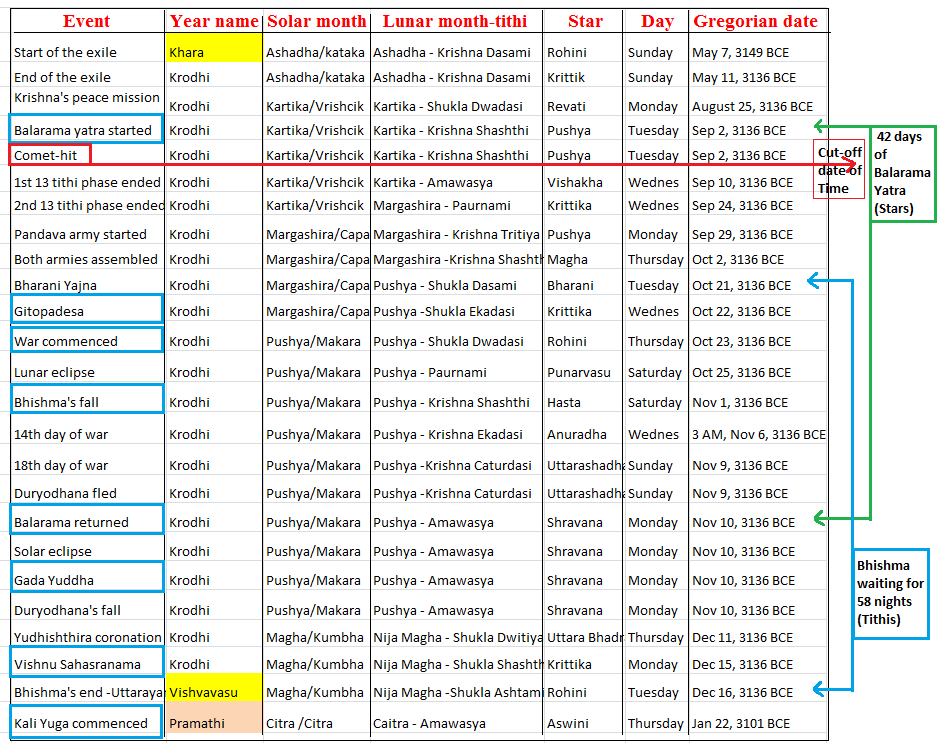
Fig 3: Mahabharata Time-line
The Tabulation corroborates the number of Tirtha yatra days of Balarama in terms of stars. Bhishma’s waiting period matches with Tithi. The Gregorian date is just for reference and not cosmically relevant. Important of all the cut-off date of time is a major feature that causes difference to time as pre-comet and post- comet period.
This tabulation establishes that the modern calendar system is not relevant for deciphering and establishing Mahabharata calendar of the 5-year Yuga, given in traditional Panchanga terms. Moreover this Yuga system does not use the true position of the sun’s northward turn (Uttarayana) in four out of five years. It is safe to derive the dates as per Mahabharata calendar for maintaining accuracy and then find out the corresponding dates in the Gregorian calendar or in the simulator.
While checking with the simulator, there comes the additional problem of sticking to the exact degree of precession of the sun on the date of the event. I used Surya Siddhanta Ayanamsa that simulates the zero ayanamsa of the Mahabharata times. Let me remind the reader that the ayanamsa was zero at the commencement of Kali Yuga! Let me also remind the readers that ayanamsa position is vital for knowing the planetary positions. The zero degree ayanamsa made my work easy because all the planetary positions of Mahabharata were given at the time of the zero ayanamsa.
In contrast any ayanamsa other than Surya Siddhanta cannot show the true position of the planets of the Mahabharata time when the ayanamsa was zero. The astronomy simulators have zero ayanamsa at any date making it ‘current’. The precession point goes around the zodiac of 360 degrees in astronomy simulators such that Kali Yuga, which the Surya Siddhanta ayanamsa shows at zero degree Aries (as it has to be), would be shown at Taurus in the astronomy simulators. So if anyone is nurturing an idea that Mahabharata date can be simulated in ‘astronomically’ in astronomy simulators, they are deceiving themselves and others besides causing immense harm to Dharma and the Indic cause.
The dating continues…to know what happened in Dwaraka after 35 years.
Wednesday, January 20, 2021
Krishna left and Kali Maha Yuga started: Resolving the controversies on Kali and Shaka (Part 27: Mahabharata date)
Vaisampayana opens the 16th chapter, Mausala Parva with these words,
ṣaṭ triṃśe tv atha saṃprāpte varṣe kauravanandana
dadarśa viparītāni nimittāni yudhiṣṭhiraḥ (16-1)
“When the thirty-sixth year (after the battle) was reached, the delighter of the Kurus, Yudhishthira, beheld many unusual portents.” (Ganguli’s translation)
viparītāni nimittāni were many - terrestrial, atmospheric and celestial that included meteor showers and unusual appearance of the solar and lunar discs. Short while later the king Yudhishthira received the news of the destruction of the Vrishinis.
The narration then shifts to Dwaraka, wherein many inauspicious and odd omens were seen for some time. Some peculiar planetary movements were noticed. The stars were repeatedly attacked by the planets. None among the Yadavas could, however, obtain a sight of the star of his birth.[1] This implies that the planets were crossing the same stars one after the other, which means that the planets were congregating together at some location of the zodiac.
Seeing this kind of planetary congregation and the other odd sightings on the earth and the atmosphere, Krishna thought that the Time has come – something similar to what was witnessed during the Bharata war. His thoughts were already written in detail in Part 21 in the context of the solar eclipse on the 19th day of the war at the time of the mace fight.
“By seeing (the adverse omens) Krishna understood that the Time (of wheel) had come to a revolution. Having seen Amawasya in Trayodasi at that time (in the past), he began to speak that Caturdasi made into Pancadasi by Rahu at the battle of the Bharatas is (there) now for our destruction.” [2]
The extended tithi of Caturdasi into Pancadasi recalled here, hints at the day being Caturdasi extending into the next day. Krishna recalled Gandhari’s curse and “understood that the thirty-sixth year had come, and that what Gandhari, burning with grief on account of the death of her sons, and deprived of all her kinsmen, had said was about to transpire.” [3]
“putraśokābhisaṃtaptā gāndhārī hatabāndhavā
yad anuvyājahārārtā tad idaṃ samupāgatam”
He also thought, “The present is exactly similar to that time when Yudhishthira noted at such awful omens when the two armies had been arrayed in order of battle.” [4]
Thinking so, Krishna commanded the Vrishnis to go on a pilgrimage to the sacred site on the sea shore. Once they reached the sea shore hell broke loose and mutual destruction of each other followed. Following the destruction of the Vrishnis, Krishna left home after summoning Daruka to bring Arjuna to take care of the women and the wealth. Hastinapur located at a distance of nearly 1400 kilometres from Dwaraka, Daruka could have taken a day to reach Hastinapur and the return journey with Arjuna must have taken another day. Daruka delivering the news of the destruction of the Vrishnis must have coincided with Yudhishthira having noticed the nimittas just then. Perhaps those nimittas marked the time of Krishna leaving. That could be Pancadasi when Amawasya turned into a solar eclipse.
After sending Daruka to Hastinapur, Krishna proceeded to the forest where he found Balarama in Yoga, leaving the earth. This must have been the day of Amawasya. Sitting down on the bare earth and thinking of Gandhari’s curse, of the previous slaughter of the Kurus and the mutual destruction of Vrishnis short while ago, he thought it was time to leave the earth and laid himself down on the earth and entered into Maha-yoga.
A hunter named Jara seeing him from a distance, draped in his famous yellow garments, mistook him for a deer and shot his arrow piercing Krishna’s heel. Krishna left the world, and Kali entered the world.
The day Krishna left the world was astronomically and historically the same day from when the 4th Maha Yuga started ticking.
The day was marked by the congregation of all the planets except Rahu at the beginning of Aries (Figure 1).The gathering of the planets was already noticed by Krishna.
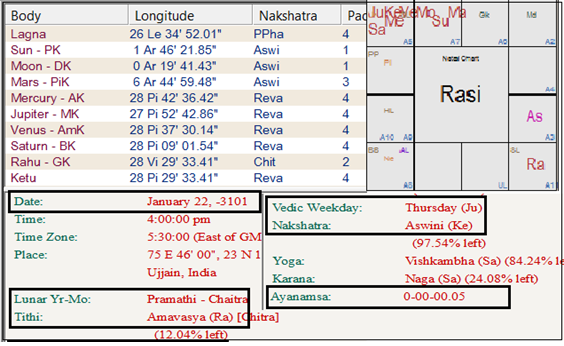
Fig 1: The day Krishna left the world – the conjunction of all the planets except Rahu
From Mahabharata to Bhagavata Purana we find a continuity of events following the exit of Krishna. In the very beginning of Bhagavata Purana, Vyasa repeats the bad omens seen by Yudhishtira at the exit of Krishna as was described in Mahabharata. When Arjuna brings the bad news about Krishna’s departure, Vyasa says (in Suta’s narration) the Kali has manifest fully at the exit of Krishna.
yadā mukundo bhagavān imāṁ mahīṁ
jahau sva-tanvā śravaṇīya-sat-kathaḥ
tadāhar evāpratibuddha-cetasām
abhadra-hetuḥ kalir anvavartata[5]
Meaning: “When the Personality of Godhead, Lord Kṛṣṇa, left this earthly planet in His selfsame form, from that very day Kali, who had already partially appeared, became fully manifest to create inauspicious conditions for those who are endowed with a poor fund of knowledge.”[6]
The day of mass conjunction of the planets marks the cut-off date of Time. The date of conjunction was 22nd January, 3101 BCE in the year Pramathi, on a Thursday when the sun and the moon joined at the beginning of Aries at the star Aswini causing a solar eclipse.
This date is coming along without any controversy by the Pancanga writers who are the custodians of time till now. The Jyothisha Siddhantas are the main sources of authority for this time computation. Unfortunately these two are forgotten or set aside inadvertently by those who are not even aware of the time Kali Yuga started or the factor that marked the start of this Yuga. Let me address those issues before going ahead with the post-Krishna events.
The ayanamsa factor.
The foremost problem is that none could get the planetary congregation in the simulators – the reasons were already written and are now repeated again. Without having incorporated in the simulators, the zero degree ayanamsa position running at the time of Kali Yuga, the Kali Yuga congregation cannot be obtained. I am able to show the congregation using the correct ayanamsa embedded in Surya Siddhanta model – the model that was personally observed over thousands of years by the ancient sages.
Even the attempts to manually calculate using the planetary longitudinal tables could not get the date or the congregation right for the reason that those tables were given from the equinoctial point of the time of the persons who computed them. To state an example the date of Aryabhata given by Govindasvamin was Shaka 444 that corresponds to 522 CE! He arrived at it for Aries 0˚ on the basis of the rate of trepidation of his time, whereas we know now that the date was 499 CE. The continuous change in the trepidation is the cause for the slightly different values, given by different Indic texts of different times of the past.
It should be noted that even at the present times, there is a sudden increase in the trepidation of the equinoctial point and the earth had rotated faster than average on 28 days in the year 2020 alone, noticed for the first time in the last fifty years.[7] No one knows if there is any correlation between the two, but what is known is that the rate of movement of the precession is not constant. This makes dating the past events difficult. Fortunately in the case of Mahabharata, the zero ayanamsa of at the beginning of Kali Yuga serves as a solid ground to corroborate the planetary combinations.
In this backdrop the proof of reliability of the Surya Siddhanta Ayanamsa for dating Kali Yuga (and Mahabharata) is seen in the stipulated congregation of all the planets except Rahu at the beginning of Aries (Figure 1)
Kali Yuga measured by planets.
We often find people making claims that kali Yuga started during the Mahabharata war, citing verses stating that Kali had ushered in. This was discussed in Part 1 and shown why it was not valid.
This claim is rejected outright on the simple premise that such a proposition makes Krishna, an avatāra of Dvapara Yuga to live across two yugas – Dvapara and Kali Yuga – which is totally against the Yuga- avatāra connection. The ratio of the number of years of the four yugas starting from Krita is 4:3:2:1 which is also the same for the number of avatāras in the four Yugas. Krishna and Balarama were the two avatāras of Dvapara Yuga; they cannot be shifted to Kali Yuga due to our inability to corroborate the Kali Maha Yuga at the time of the exit of the two.
Any reference to Kali beforehand could therefore suggest the decline in Dharma and not the arrival of the Kali Yuga, mainly because the Yugas are noted in terms of the planetary movements. Krishna noticed it in the planets crossing the same stars one after the other. The Yuga concept is basically about Time and we have seen how Time is cosmically created and not by what we do. Siddhantas are the authority for deciding the date of the Yuga.
Aryabhata says,
“The Yuga, the year, the day and the month commenced simultaneously at the beginning of the light half of Caitra. This time which is without beginning and end, is measured with the help of planets and the asterisms of the celestial sphere.”[8]
The planets and the stars, being the factors of measurement of the Time of the Yuga, the claims that Kali Yuga started at the time of war are automatically rejected.
In this statement of Aryabhata, there is a scope for a controversy. Commencement at the light half of Caitra could refer to the solar month because the lunar month soon after the conjunction was Vaishakha. Since the first day of the Yuga was counted from the day after conjunction, i.e. Shukla Pratipat, it could not have been lunar Caitra unless it was Nija Caitra. In the absence of an evidence of an Adhika masa at the time of conjunction (in the simulator), to be followed by Nija Caitra, it is deduced that the verse refers to the waxing phase present in the solar Caitra or Mesha. The lunar Vaishakha starting from the first day of the Yuga explains why the year beginning is reckoned from lunar Vaishakha in some parts of India.
The other popular Siddhanta, namely Siddhanta Shiromani authored by Bhaskara II repeats the same, but qualified with an additional input. It states,[9]
“Six Manus had elapsed in this Kalpa, thereafter thirty seven yugas, as well as three yuga padas, namely, Krita, Treta and Dvapara. Further 3179 years of this fourth yuga pada namely Kali have elapsed by the end of the Shaka king.”
3179 is the number of elapsed years since Kali Yuga began. This marks this 3rd Shaka Era which is the current Era of Shalivahna Shaka. Many olden Pancanga aphorisms are there to calculate any date in this Shaka starting from the first year of the Shalivahana Shaka in 78 CE. By adding 3179 to the current year of the Shaka one gets the Kali Year date which started in 3101 BCE.
This knowledge is now getting derailed and those having no inkling of any of these concepts are bringing in “Cyrus the Great”, a Mleccha into the picture and claim that his Era was referred by Bhaskara II.
Resolving the confusion in Shaka Era.
With information dissemination happening now, they bring in all terms Shakendra Kala, Shakabhoopa Kala and Shaka-anta kala in to Kali Yuga Time scale.
As far as Kali Yuga time scale is concerned only six shaka eras have been mentioned. They are [10]
Yudhistira Era
Vikrama Era
Salivahana Era
Vijayabhinanda Era
Nagarjuna Era
Bali Era.
The years allotted to all these Eras add upto 4,32,000 years – the exact duration of Kali Yuga.
All these are based on some sort of cosmic time measurement.
For example in Yudhsihthira shaka, the year was marked by Uttarayana.
It changed into Caitra in Full moon in Vikrama Era and Caitra No-moon in Shalivahana.
Moreover the Pancanga features (Year, month, paksha, star and weekday) would repeat at the lapse of 3780 years. [11] This means a combination of these five on a day, say, in the year 1 of kali Yuga (3100 BCE) would repeat in the year 681 CE. This causes problems in identifying dates of the past beyond 3780 years. It is my conjecture that a new era was necessitated to avoid this. The initial one was Vikrama Era which however failed to be compatible with most of India since it started the year in the Full Moon which was not in vogue in many parts of India. Perhaps due to this, a revision was introduced in 78 CE by ushering in Shalivahana Era.
The next Era is going to start after 18,000 years. Not surprising given the fact that our countrymen have to go that long to undersatnd the basic features of Kali Yuga!
To restrict these explanations going too long, met me focus on the contentious issue, on Shaka. That is a verse in Brihat samhita by Varahamira which people are using to push in their wrong theory of Shaka. To know what that verse says, let me do a word for word meaning of the verse.
The verse states,[12]
आसन् मघासु मुनयः शासति पृथ्वीं युधिष्ठिरे नृपतौ।
षड्-द्विक-पञ्च-द्वि (२५२६) युतः शककालस्तस्य राज्ञस्य॥
आसन्= āsan = Halting, stopping, abiding, staying, sitting (third person plural present imperfect class 2 parasmaipada √as )
मघासु = maghāsu = in the lunar mansion Maghā (feminine locative plural stem: magha)SB 12.2.31
मुनयः = munayas = the sages (masculine nominative, vocative plural stem: muni)
शासति = śāsati -= to command, to control (third person plural present present class 2 parasmaipada √śās)
पृथ्वीं = pruthvim = earth (Accusative)
युधिष्ठिरे = in Yudhihsthira (singular masculine locative)
नृपतौ = king (singular masculine locative)
षड्-द्विक-पञ्च-द्वि = 2526
युतः = yutas = Binding, fastening, attaching, going (masculine nominative singular past passive participle stem: yuta)
शककालस्तस्य = shaka kālas tasya – his shaka kaala,
Tasya = about this (SB 10.89.2), at him (SB 11.23.9), by him (SB 1.9.17, SB 9.14.42, SB 10.70.24)
राज्ञस्य = by (of) the king (singular masculine Genitive)
Overall meaning:
The earth was controlled by the king Yudhishthira in his shaka kala of 2526 (years) (when) the Saptarṣis (muni) were in Maghā (star)
The Shaka era mentioned here is that of Yudhishthira and not of anyone else, particularly not “Cyrus the Great” which is a complete anathema to the concept of Shaka.[13]
Why this specific year stated?
The speciality of this date – Yudhishthira Shaka 2526 when the Sapta rishis were in Magha is demystified in Srimad Bhagavatam!
Srimad Bhagavatam (SB) also talks about the Saptarishis on Magha.
“When the constellation of the seven sages is passing through the luanr mansion Maghā, the Age of Kali begins. It comprises twelve hundred years of the demi-Gods”[14] (Figure 2)
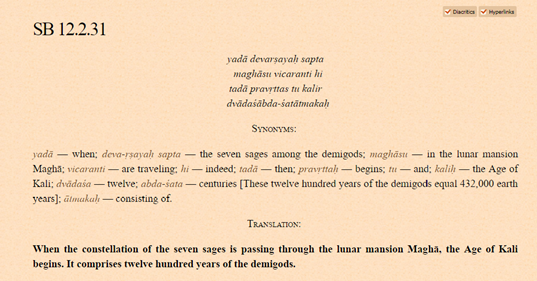
Fig 2: Kali begins when the Seven sages pass through Magha
This is reiterated in the next verse that “When the graet sages of the Saptarishi constellation pass from Magha to Purvashadha, Kali will have his full stregnth, beginning from King Nanda and his dynasty.”[15] (Figure 3) This date corresponds to Brihat samhita date of Kali / Yudhishthira 2526. After 2526 years, the true Age of Kali begins.
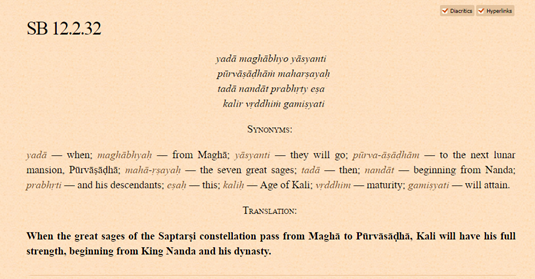
Fig 3: Kali aggravates further
Then what was the kali at 3101 BCE when all the planets congregated and krishna left? Vyasa clarifies in the very next verse that, “ Those who scientifically understand the past declare that on the very day that Lord Sri Krishna departed for the spiritual world, the influence of the Age of Kali began.”[16] (Figure 4)
Fig 4: The original date of Kali at the exit of Krishna
Vyasa repeats this idea in two verses before starting to identify Magha related Kali.[17]
So the whole issue about Brihat Samhita verse on saptarishis in Magha star is not about a Shaka era of Cyrus, but about deterioration of the Dharma in Kali Yuga. The verse is a re-statement of Srimad Bhagavatam verse.
By Yudhsithira Shaka 2526, the command of Yudhishthira’s rule, his code of ethics and Dharma seemed to have faded. That date is marked by the Saptarishi in Magha verse. In the next 1000 years it further deteriorated. Another 1500 years passed away before our current times. There is nothing worthy of telling for the state of Kali now and so Vyasa refrained from saying anything beyond.
The bungling of Mahabharata date and the forgotten knowledge Kali Yuga testify how we are beyond redemption.
With a heavy heart let us go back to where we left.. Arjuna arriving at Dwaraka.
[1] Mahabharata: 16-3-14
parasparaṃ ca nākṣatraṃ hanyamānaṃ punaḥ punaḥ
grahair apaśyan sārve te nātmānas tu kathaṃ cana
[2] Mahabharata: 16-3 -16 & 17
[3]
[4] Mahabharata: 16-3-20
[5]Bhagavata Purana: 1-15-36
[8] Aryabhatiya: Ch.3- Kalakriya Pada. “Aryabhatiya of Aryabhata” edited and translated by Kripa Shankar Shukla.
[9] Siddhanta Shiromani: Madhyadhikara, section I, v.28
[10] Kalidasa, “Jyotirvidabharana” 4-89
[11] LCM of 60, 12, 30, 27 and 7 for the features given.
[12] Brihat Samhita: 13-3
[13] The founder of the Shaka era in Kali Yuga is one who defeated a Shaka (Mleccha) ruler.
[14] Srimad Bhagavatam: 12-2-31
[15] Srimad Bhagavatam: 12-2-32
[16] Srimad Bhagavatam: 12-2-33
[17] Srimad Bhagavatam: 12-2- 29 & 30
Thursday, January 21, 2021
Locating Krishna’s Dwaraka now under water (Part 28: Mahabharata date)
The Pandavas received the information from Daruka that the Vrishnis along with the Bhojas and Andhakas and Kukuras had all been slain. None of them at that time knew that Krishna and Balarama also had left the world. Grief stricken Arjuna rushed to Dwaraka only to be received by the crying women and children. This must have been on the day of solar eclipse – the day Krishna left.
After listening to the developments from everyone around, Arjuna asked them to be ready to leave the city at sunrise on the 7th day from then.[1] He expected a deluge by the 7th day. This is supported by astrological Samhitas that those who live near water or live by the sea would perish if an eclipse occurs at Pisces.[2] The congregation of planets occurring at the beginning of Aries, the Amavasya and the eclipse must have started at Pisces. The effects would be seen by the seventh day after the eclipse.
This is similar to the apprehension expressed by Drona on the 7th day after the lunar eclipse, fearing the fall of Bhishma. ( Refer Part 20) Depending on the other features, namely the nimittas noticed around that time, the prediction is made. Here a deluge was predicted but interestingly none of the nimittas of the kind expressed by Drona were reported anytime in the seven day period or on the day the sea water entered Dwaraka! Particularly there is complete absence of mention of the meteor shower or the sun looking obscure or any such events that we had been regularly reading in the Mahabharata right from the time Krishna started his peace mission.
The message is clear: there was no cosmic impact at the time of Krishna leaving the earth; there must have been an underwater earthquake or tectonic movement in the ocean region causing tsunami waves in whose path Dwaraka must have been situated.
Getting back to the events, the night passed off – that must have been the night of Amawasya that had seen a solar eclipse. The next morning, Krishna’s father Vasudeva passed away. After finishing the funeral of Vasudeva, Arjuna went out in search of the missing (dead) Vrishnis and Krishna and Balarama. They were all spotted. Not much description of how the funeral took place is given. Then every one of them got ready for leaving Dwaraka – the city that was built by reclaiming the land from waters.
Where is Krishna’s land now?
The marine excavations done off Bet Dwaraka showed that occupation started only from 1500 BCE! This is not the date of Mahabharata or Krishna. So this could not be the region of Krishna’s Dwaraka.
We have to think in the way Arjuna could have planned the evacuation to get a hint at the location of Dwaraka. He expected sea water to rush into the city. The sea water would also have entered the rivers and streams in such case, forcing the evacuees to avoid the regions around the rivers and the low-lying lands. But what does Mahabharata say? It says that as the people marched out of the city, with sea water entering the regions they left behind, they were taken by Arjuna through pleasant forests and mountains and by the sides of delightful streams! The location off Bet Dwaraka doesn’t support an immediate shift to forested and mountainous regions.
Figure 1 shows the physical map of Gujarat with Bet Dwaraka excavation region boxed. The arrow marks show the probable direction of the tsunami waves.

Fig 1: Physical map of Gujarat
Evacuation is practically impossible to the east or the north of Bet Dwaraka. The entire Kachchh region must have borne the brunt in the event of a tsunami. That was perhaps the reason why this place was not occupied till 1500 BCE!
South east of Bet Dwaraka is also a tricky terrain with many rivers draining into the Arabian Sea. The tsunami wave coming from west would practically enter all the water ways draining into the Arabian Sea. Moreover the entire landscape adjacent to Bet Dwaraka is flat plain. So this region is practically ruled out as the original region of Krishna.
Figure 2 shows another map of Gujarat giving the elevation features in the peninsula.

Fig 2: The elevated regions of Gujarat.
The central region and the south west (Gimar Hills) give us a fairly good idea of the regions that could escape inundation. The high lands close to the coast of south west Gujarat offer quick escape from the surging sea.
It must be noted here that the region of Krishna’s fall was at Veraval near Somnath temple. The place of Krishna’s fall must have been retained in memory for all these millennia and this location cannot be ignored in the search for Krishna’s Dwaraka. We must also remember that there was another Dwaraka even before Krishna built his Dwaraka. That Dwaraka was ruled by Akrura. It is not known what happened to that place or whether that was the present Dwaraka housing Dwarakadish temple. But our search can be fine-tuned to the region next to Verval, Krishna’s resting place and Somnath temple that was the Prabhas Kshetra of Mahabharata. (Figure 3)

Fig 3: The places associated with Krishna.
From Harivamsa it is known that Krishna and his people stayed in tents on the sea shore at the time they were building their city. By tradition, Mul Dwaraka is said to be his first landing place. Figure 3 showing Mul Dwaraka, Prabhas and Veraval close to each other makes me presume that Krishna’s Dwaraka was somewhere in the waters off this part of the coast. Krishna directing the Vrishnis to make Tirtha yatra at the sea shore must have been to the Prabhas Kshetra. This is quite far off from Bet Dwaraka or Dwarakadish but close to Krishna’s Dwaraka if it was built off the shore of Mul Dwaraka. (Figure 3)
Makran – the tsunami generating region
In support of tsunami at this region, there is a strong evidence of a perennial danger zone off the Makran coast. The Makran Subduction Zone lies at the plate boundary between the Arabian and Eurasian plate within the northern Arabian Sea, that can impact the shorelines of the Arabian Sea in an event of a subduction, says the authors of a research on the impact of 1945 tsunami. [3]
This subduction zone had been causing havoc periodically. With the presently available inputs it is suspected that one such event at this region caused the fleet of Alexander anchored at Karachi to be lost in a tsunami.[4] In this research, the author, Mohammad Mokhtari of the International Institute of Earthquake Engineering simulated the wave pattern of the tsunami in the event of a stress (earthquake) at the subduction zone. (Figure 4)

Fig 4: Spread of tsunami waves in the event of a subduction stress at Makran coast.
The waves traveled upto Seychelles in 1945 earthquake at Makran coast but a look at the impact on the shores of India shows that Bet Dwaraka and Rann of Kachchh would bear the brunt heavily. Dwarakadish is also in the line of heavy damage. It is theorized that a tsunami generated at Makran would reach Dwarakadish in 140 to 185 minutes.[5] These places must have suffered every time the Makran coast line was stressed. It must be remembered that this region was not at all inhabited until 3500 years ago. Unfortunately we are fed with the information that this was Krishna’s Dwaraka.
Looking at the Figure 4, the waves as they surge forward towards the south would spread laterally dashing on the shores of western Gujarat where Vearaval and Prabhas are situated. But this part of the coast being slightly higher, no big damage could happen. Only if Krishna’s Dwaraka was on the direct path of the tsunami waves, it could have suffered complete inundation with the waves damaging the structures and even washing them through the Arabian Sea as they surged southward, with the result that the city would be completely flattened leaving no trace of its existence. (Figure 5) We could get evidence of civilization in the Khambhat region upto 9000 years BP, which is somewhat sheltered from tsunamis, but a city off Mul Dwaraka could never escape the wash-out.

Fig 5: Krishna’s Dwaraka lying on the path of the tsunami waves
A massive earthquake at Makran coast would send a series of waves down the south wiping out everything on the way. So it is very difficult to get evidence for a city in the circled part in Fig 5. The subduction being an ongoing motion, the circled region must have experienced several tsunamis in the last 5000 years. From the circled region the evacuees could easily escape through the highlands near Mul Dwaraka and Prabhas, by avoiding rivers and streams initially, though the tsunami impact on the waterways in this part would be minimal.
So we need to patiently search this region to look for 5000 year old imprints. While searching we must remember an Indian trait. Indians never waste any metallic item. The search for weapons of war or metallic vessels anywhere in India would yield no result mainly because Indians used to recycle any metallic item. They would not just throw away or bury a weapon or a metallic vessel. At the most we can dig out pottery shreds in the land regions. The traditional western classification of copper, bronze and iron ages for Indians would be thoroughly misleading. In this region of Dwaraka, only deep foundational boulders can be located here and there, provided they were not washed away by the tsunami waves.
Comet hit before the war and tsunami at the exit of Krishna.
The next issue that we must bear in mind is that there was only one event of cosmic impact that is now scientifically identified as Piora Oscillation, discussed in Part 15. A comet hit around the year 3200 BCE caused world-wide changes in temperature causing a Z-shaped temperature pattern in the EOO wave that was plotted by the researchers. [6] (Figure 6)

Fig 6: A cosmic impact around 3200 BCE indicated by a star
The blue line in Figure 6 touching the star marks a cosmic collision around the year 3200 BCE which caused the temperatures to be lower than normal until 2900 BCE. The exact year of this collision was found out to be 3136 BCE from the Mahabharata text. This impact is theorized to have caused a depression near the Caspian Sea, causing the sea water to fill this depression. Fig 7 shows the impacted regions deduced by the researchers. [7]

Fig 7: Lake formed by a comet-hit near the Caspian Sea.
Around the same time the Burckle Crater to the east of Madagascar in the Indian Ocean was also formed, though its exact date had not yet been found out. This also was formed by a cosmic impact and the tsunami wave generation had been studied by many. This generated waves going eastward and southward to some extent and not northward as to reach Dwaraka. Figure 8 shows the tsunami propagation from the Burckle Crater which should have affected south India badly, particularly Kerala and Kavātam, the Pandyan Capital at the tip of South India before it could reach Dwaraka. But there is no history of damage to Kavātam in Tamil texts which however suffered submergence only around 1500 BCE.

Fig 8: Probable tsunami propagation of comet-hit at Burckle Crater
(Pic credit: https://alchetron.com/Burckle-Crater )
This crater is most likely to be part of the 3136 BCE comet-fall. Mahabharata referred to the fall in the ocean causing the waves that however did not cross the shores (Part 13)
In contrast to the comet-impact, the floods at Dwaraka after Krishna’s exit came up with no comet fall. This is proof for underwater earthquake causing the tsunami. The only probable candidate is the Subduction zone at Makran coast.
A Biblical research sponsored by http://web.stanford.edu/ listed down the global flood catastrophe events and presented them as a graph. (Figure 9) The Mayan calendar date coming immediately after the Mahabharata war at 3114 BCE offers a benchmark to compare the flood events. I have marked the Mayan date by running a blue line across it. The figure shows that the flood at Dwaraka has no nearest origin, by which we are made to deduce that it was a localized flood and not a global event as the comet-hit was.

Fig 9: Flood events around 3200 to 3000 BCE
The Biblical flood is hypothesized at 3000 BCE and around 3136 BCE (comet hit). If it coincides with Dwaraka submergence, then Makran subduction is the most likely candidate. Its wave propagation could enter the Persian Gulf. The plate movement was found to have caused earthquakes in the Persian Gulf too causing tsunamis in the regions adjacent to the Gulf coinciding with the Biblical flood. [8]
In the ultimate analysis a fresh approach is needed to locate Dwaraka off the coast of Mul Dwaraka and the probable tsunami generation at Makran coast in the past.
With this let us continue our journey along with Arjuna to the places he had taken the people of Dwaraka.
[1] Mahabharata: 16 – 8- 12
[2] Brihat Samhita: 5- 42. “If when in the sign of Pisces (Mina), the products of the sea beach and of the sea, men of respectability and of learning and persons that live by water will suffer.” (Translation by N.C.Iyer)
[3] https://www.researchgate.net/publication/258256969_The_impact_of_the_1945_Makran_tsunami_along_the_coastlines_of_the_Arabian_Sea_Northern_Indian_Ocean_-_a_review
[4] https://www.researchgate.net/publication/221921240_Tsunami_in_Makran_Region_and_Its_Effect_on_the_Persian_Gulf
[5] “Tsunami hazard and alert system for Western Coast of Gujarat” https://www.researchgate.net/publication/265920682_Tsunami_Hazard_and_Alert_System_for_Western_Coast_of_Gujarat
[6] “Climate Pattern recognition in the Mid-Holocene (4800 BC to 2800 BC, Part 3) https://www.knowledgeminer.eu/climate/pdf/hc3.pdf
Friday, January 22, 2021
From Mehrgarh to Saraswati, Dwarka people spread and started the Early Harappan culture (Part 29: Mahabharata date)
On the 7th day after Krishna left on that fateful day of a solar eclipse when all the planets except Rahu congregated at the beginning of Aries, the people of Dwaraka started moving out with Arjuna leading them. The sea swallowed the entire city by the time they left. The entourage consisting of women, children and elders accompanied with servants had moved slowly taking rest at forests, mountains and near the streams. Immediately reaching on the Gujarat coast in the west they must have moved to the high lands and then entered the plains (Figure 1)

Fig 1: The escape route of Dwaraka people.
In Figure 1, “D” represents the location of Krishna’s Dwaraka and “B”, Bet Dwaraka which was not inhabited at the time of Mahabharata. The tsunami waves going southward could wash out Dwaraka on its path. Laterally the waves could hit the west coast of Gujarat but not intrude inland except through the waterways draining into the west. The escapees must have climbed on the highlands surrounding the Girnar Hills immediately after leaving Dwaraka. From there crossing the mountains and streams in a slow march they reached the country of five rivers.
“Arrived at the country of the five waters, the puissant Dhananjaya planted a rich encampment in the midst of a land that abounded with corn and kine and other animals”, says Mahabharata.
sa pañcanadam āsādya dhīmān atisamṛddhimat
deśe gopaśudhānyāḍhye nivāsam akarot prabhuḥ[1]
By the specific reference to the five rivers, it is known that the Vrishnis had spread far and wide in the upper region of the Indus River. At that time of settling down in this region, the Mlecchas from the west attacked them and had taken the Vrishni women including those of high order, i.e. royal families. This is an indication of the genetic outflow of mtDNA and the Y-chromosome of the native Indians through the male children of the Vrishnis to the west of the five rivers as early as 3101 BCE.
Unable to rescue them, Arjuna further moved with the remaining women and children to Kuruskhetra. This reveals that the Dwaraka people did NOT settle down in the Indus region. He settled the people at different places. This must be around Kurukshetra.
Then an interesting version appears. Kritavarma and Satyaki were the two main persons who were responsible for starting the quarrel that led to the total annihilation of the Vrishnis and the Andhakas. Of them Kritavarma sided with Kauravas and Satyaki with Pandavas in the war. So there was ideological difference between them, expected to have spilled over to their families and supporters. Arjuna did not put them at the same place. He settled the son of Kritavarma at Mattikavata (Matrikavat) along with the Bhojas. Bhojas were already settled in the regions west off the Indus. Now they were grouped under Kritavarma’s son.
The family and supporters of Satyaki were settled down on the banks of Saraswati! The year was 3101 BCE coming under the classification, “Ravi aspect of Hakra Phase” between 3300 BCE and 2800 BCE! Figure 2 furnishes the classification from Harappa.com[2]

Fig 2: Settlement of Dwaraka people start from Ravi phase.
Then Arjuna established Vajra, the great grandson of Krishna in Indraprastha as its king. The women folks of Akrura went further north into the forests. Satyabhama, the dear wife of Krishna went to a place called Kalpa beyond the Himavat. There is a place by name Kalpa in Himachal Pradesh. (Figure 3)

Fig 3: Kalpa where Sathyabhama settled down
The families and servants who accompanied her must have settled there and spread out of India in later generations.
After settling the people of Dwaraka in all these places Arjuna went on to meet Vyasa. By then seven months were over, says Srimad Bhagavatam.[3] When Arjuna informed Vyasa of Krishna’s exit, Vyasa spoke about the change of time and that time has come for the Pandava brothers to leave the earth.[4] It was only after meeting Vyasa Arjuna went on to meeting his brothers to convey the news of Krishna’s exit. Until then no one knew about Krishna’s end.
From Mahabharata to Srimad Bhagavatam we find a continuity of events following the exit of Krishna. In the very beginning of Srimad Bhagavatam, Vyasa repeats the bad omens seen by Yudhishtira at the exit of Krishna as were described in Mahabharata. When Arjuna brings the bad news about Krishna’s departure, Vyasa says (in Suta’s narration) that Kali has manifest fully at the exit of Krishna.[5]
In the very next verse it is said that Yudhishthira having understood the arrival of Adharma (adharma-cakraṁ) prepared to exit the world.[6] It is again repeated that the arrival of Kali Yuga (kalinādharma) was perceived by the younger Pandavas prompting them to leave the earth.[7] Thus there is consistency in the narration on the change of the Yuga and the birth of a new Yuga, and the narration continuing from Mahabharata and taken over to Srimad Bhagavatam by the same author Vyasa.
Again in the 12th chapter of Srimad Bhagavatam, we find the repeat of the start of the Kali Yuga after Krishna’s exit. From those verses it is known that the sages including Vyasa had gathered together and notified the start of the new Yuga of Kali on the day Krishna left the world when the planetary measurement of the Yuga also concurred perfectly.[8]
The Yuga began at the end of the great Itihasa of Mahabharata!
Connections between the settlements and the Harappan culture.
It is not just a coincidence that the Early Harappan started developing at the end of Dwaraka flood. The people of Dwaraka were mainly established along the banks of the River Saraswati. A paper by Chatterjee et al gives a graphic description of the sudden growth of settlements along the river Saraswati from the time of Mahabharata.[9] The arrow mark in Figure 4 shows the first growth of settlements that coincide with those of the kith and kin of Satyaki!

Fig 4: The settlements on the banks of R.Saraswati around 3101 BCE
The gaps in the settlements show the loss of the river even as early of Mahabharata time. The settlement is dense in tune with the Mahabharata narration that after reaching Kurukshetra, they turned southward along the river Saraswati. This stretch containing more number of settlements of the entire Harappan regions discovered so far, goes to show that the Dwaraka people, particularly the friends of Krishna remained more or less within present day India. Their choice of Saraswati shows the continuity of the Vedic culture in those days of which Kalibhangan has thrown up some evidences.
Who were in the Indus region.
Earlier in Part 15 we showed the destruction at the Lower Town of Mohenjo-Daro, possibly caused by the fragment of the comet falling there. We also showed that it was in the Sindhu country of Jayadratha.
There is least chance of the Dwaraka people having mingled with the Saindhavas (Sindhu people). This is known from the Ashwamedha Parva of Mahabharata when Arjun went to the country to bring them under the control of the Pandavas. This shows that the country of Jayadratha remained independent after the war. When the Ashwamedha horse went to the Sindhu kingdom, the Saindhavas refused to budge and preferred to fight with Arjuna taking revenge for the death of their king Jayadratha.
It was a fierce battle where Arjuna too suffered, but then Dussla, the daughter of Dhritarashtra and the wife of the slain Jayadratha approached Arjuna with her grandson in her hand! Her son Suratha died on hearing that Arjuna had arrived at the country to annex it. Seeing the Saindhavas losing the battle, Dussala came to Arjuna, showed the child to him saying that the child sought protection from him, Arjuna, the maternal uncle. Like Parikshit who was born after the war, this child was born after the war; let that child live with his countrymen, not troubled by the Pandavas. Arjuna agreed to do so and left. There is no mention of the Saindhavas agreeing to pay tribute to the Pandavas.
So the Sindhu country remained out of control of Hastinapur. The grandson of Jayadratha must have ascended the throne and controlled the Sindhu region as Jayadratha did. There were 10 Sindhu countries at the time of Jayadratha covering the entire region of the five rivers of Indus and extending upto Gandhara, Vāhlika (also known as Bactria) Kāmboja and Yavana, connected by marriage alliances. So the people of the Indus region had similarities with all the places mentioned here. There is a clear demarcation between the Sindhu people and the Saraswati people.
That we cannot club them together is established by the famous priest king found at Mohenjo-Daro dated at 2200-1900 BCE. (Figure 5) The figure with the beard like a saint has no moustache! A shaven upper lip is the identity of a Mleccha, ordained to be so right from the time of Sagara, an early ancestor of Rama. This information is repeated in Mahabharata and Vishnu Purana.

Fig 5: The ‘Priest King’ with shaven upper lip.
Ear piercing is an important Vedic ritual. The priest King’s ear doesnot bear any evidence of a ear-bore or having worn an ear ornament. Similar image is found in Bactria too, though Bactria has evidence of presence of Vedic people right from Ramayana times. The Garuda emblem of Krishna is found in Bactria, so also the image of Krishna, but they were later period than Mahabharata. This implies to and fro movement had happened and Vedic and non-Vedic practices had alternated.
But Sindhu remained out of Yudhishthira’s command and showed signs of degradation of Vedic practices, the foremost evidence being the Priest king.
The next region of interest is Mattikavat (Matrikavat) the capital of Salwa who was ill-disposed to the Vrishnis. He overran Dwaraka when Krishna was in the Rajasuya yajna of the Pandavas, but was revenged by Krishna who went over to Matrikavat to attack him. At the time Salwa attacked Dwaraka, Kritavarma was in Dwaraka. Krishna came to know of the details of Salwa’s attack only from Kritavarma. Perhaps, Kritavarma accompanied Krishna in his attack on Salwa at Matrikavat. So some connection was there for Kritavarma with Matrikavat. Perhaps his wife had come from that country. Perhaps that made Arjuna settle Kritavarma’s son in Matrikavat.
Where was Matrikavat?
Going by the etymology of the name Matrikavat, the place had something to do with Mothers! Mehrgarh in Baluchistan is the one place seen with mother figurines with child in hand. (Figure 6)

Fig 6: Mother with child figurine found in Mehrgarh
Mehrgarh perhaps was corrupted form of Maa-ghar, from Mother’s house that had its origin in the name Matrikavat. This place was the oldest site as far as archaeological evidences are available, so too are the Indic connections. Satyavan, the husband of Savirti belonged to the Salwa kingdom. He lived before Ramayana times, because Satyavan and Savitri were remembered by Sita in Ramayana.[10] So Mehargarh was very much part of the Indic past long before Ramayana.
There was movement of people and plants from Mehrgarh to western Gujarat often quoted by researchers as though people came from outside to India. But Mehargarh, also known as Matrikavat was a Vedic territory long before Mahabharata and was occupied by Kritavarama’s lineage whose roots were in Gujarat. A surprising connection stretching upto South East India exists in the name “Kacch”. Mehrgarh is in Kacchi plain. The gulf north of Gujarat is Rann of Kacch. Down south, Kanchipuram’s original name was Kacchi! That is how it is mentioned in Tamil texts. Further towards Srilanka, there is “Kaccha” theevu (island). All these have the same meaning, “something in between” or “at the border of”.
Let me briefly state a few more Mahabharata impressions outside India. One is Uluka, the son of Shakuni. Uluka means Owl. The owl emblem appears in Anatolia in the 1st millennium BCE. The coins featuring owl on one side have the faces of the kings with ear ornament! [11]

Fig 7: Coin of Kheriga, Dynast of Lycia (circa 450-410 BCE)
The Satarap of Mesopotamia seen with ear garments and owl emblem (Figure 8)[12]

Fig 8: Coin of Mazakes as Satrap of Mesopotamia in the Alexandrine Empire (331-323-2 BC)
The next interesting feature is the Gandaberunda, the emblem of the Mysore kings, now made the State emblem of Karnataka, which seems to be a modification of Nakula’s insignia!
According to Mahabharata, Sharaba was the emblem of Nakula. The bird with two faces is seen in Turkey, Albania and was the emblem of Ninruta, a god of Mesopotamia.
Ninruta’s double headed eagle symbol is exactly like the Gandaberunda which was also like Sharabha, the emblem of Nakula.

Fig 9: The double headed eagle of Ninruta of Mesopotamia.

Fig 10: National flag of Albania
All these have appeared only after the Mahabharata period. They appear in Hittite kingdom too. (Figure 11)

Fig 11: Bagazkoy Double headed eagle.
Today researchers of the west are writing that Hittite is the origin of this double headed eagle. [13] The region was known as Hatti – a corrupt form of Hasti (elephant) that was the name of Nakula’s capital (Hastinapur). It is Hatti in Pali and Atthi in Tamil with the same meaning. The famous Mitanni treaty quoted by the AIT proponents having references to horse taming is not surprising given the fact that Nakula was a skilled horse tamer. How did Nakula’s skill and his emblem get into Hittite of the mid - 2nd millennium BCE, when Nakula’s period was more than a millennium before that? A logical derivation is that his control had extended there and his men had spread over there.
The next interesting feature is the Kish dynasty which appeared in Mesopotamia after a flood around the same time of the Dwaraka deluge. The name, the artifacts and the Indus seals make me wonder whether the people of Dwaraka were dispersed through the Persian Gulf at the time of Dwaraka deluge but retained connections later. I will divulge the details in my book and restrict here with hints. (Figure 12)

Fig 12: Murex shell bearing the name of "Rimush, king of Kish", c. 2270 BC, Louvre.
Harappan was Post Mahabharata culture
Most of the animals in the Indus seals are found in the Standards of kings who fought the Mahabharata war – the prominent among them being Varāha – the Unicorn found in the Standard of the Sindhu king, Jayadratha.[14] Almost all the Unicorn seals were found only in the Sindhu region ruled by Jayadratha with ten kingdoms under him.[15] In addition, Jayadratha wielded influence till Vāhlika (also known as Bactria) through his marriage with the women of Gāndhāra, Kāmboja and Yavana all of them forming part of BMAC[16]. So in all these places, the authority of the Unicorn (his insignia) must have been running during Mahabharata times and before and after wards
The other animals of the Harappan seals have their presence in the Standards of kings and chieftains of the Mahabharata period. For example, the Bull image having 2nd highest occurrence in Harappan seals adorned the Standard of Kṛpācārya, the brother-in-law of Droṇa and maternal uncle of Aswattama. It continued in Pallava emblems – the Pallavas claimed ancestry from Aswattama. That means the Harappans were not somebody outside the Indic culture, but Mahabharata people whose descendants continued to live in different parts of India. The Harappan Bull seals have appeared outside India, in Mesopotamia, Gulf, Bactria and Iran hinting at trade and migration in some cases.
The Varaha emblem continued to appear until a few centuries ago. Gurjara Pratiharas, Kadambas, Chalukyas and Vijayanagra kings had Varaha emblem only. Even the measurement of gold was known by Varaha units. All these are proofs of continuing Mahabharata lineages in India, though some of them had forgotten their origins.
Salwa and Duryodhana had Elephant in their banners; Bhīma, Sātyaki and Uttara had Lion; Pradyumna, Kṛṣṇa’s son had Makara while Sahadeva had Swan in his flag. All these animals are found in the so-called “Harappan art”. It is easy to dismiss them as post-Harappan, but what stands out is that most of the frequently recurring animal motifs in the seals belong to the losers in the Mahabharata war! After the war, the victors must have been leading royal life in their palaces and going about with their Kshatriya duties. The losers had become Kshatriya vratya-s– by having given up fighting and started engaging in Vaishya-hood. The Saindhavas refused to be controlled by the Pandavas, but retained their independence and led a subdued life by taking to trade.
In the final analysis, Mahabharata had left a legacy in the Harappan culture. The Sindhu and Saraswati culture were caused by people of different ideologies - aptly to be known as Saindhava - Satyaki culture or just Post-Mahabharata culture. Therefore a separate study is needed particularly in the light of researches on animal food ingestion noticed among the Harappans. The cattle growing Vrishnis were not animal food eaters. One of the recent findings is that Kotda Bhadli in Gujarat was the Milk capital during Harappan culture 4000 years ago. [17] The place name reminds of the comet-hit because Bhadli means ‘omen’. Kotda was once a Fort.
Forgetting the Mahabharata connection and its date at 3101 BCE when the major dispersal occurred along the River Saraswati, we are losing a lot by our ignorance. A lot more needs to be written on these evidences, but I am closing the post Mahabharata history with this and with an epilogue tomorrow – the 30th and the last part, completed in one cycle of the lunar month.
(To be continued)
[1] Mahabharata: 16-8-43
[2] http://www.harappa.com/indus4/e1.html
[3] Srimad Bhagavatam: 1-14-7
gatāḥ saptādhunā māsā bhīmasena tavānujaḥ
nāyāti kasya vā hetor nāhaṁ vededam añjasā
[4] Mahabharata: 16-9- 36
kālo gantuṃ gatiṃ mukhyāṃ bhavatām api bhārata
etac chreyo hi vo manye paramaṃ bharatarṣabha
[5] Srimad Bhagavatam: 1-15-36
[6] Srimad Bhagavatam: 1-15-37
[7] Ibid. 1-15-45
[8] Srimad Bhagavatam: 12-2-33
[9] Chatterjee et al, “On the existence of a perennial river in the Harappan heartland”, Scientific Reports, | https://doi.org/10.1038/s41598-019-53489-4
[10] Valmiki Ramayana: 5-24-10
[11] https://en.wikipedia.org/wiki/Kheriga#/media/File:DYNASTS_of_LYCIA._Kheriga._Circa_450-410_BC.jpg
[14] Mahabharata: 7- 102
[15] Mahabharata: 8- 5 and 3- 265
[16] BMAC is an abbreviation of Bactria- Margiana Archaeological Complex. It combines Bactria consisting of northern Afghanistan around modern Balkh and south-eastern Turkmenistan, and Margiana presently known as Merv, located near Turkmenistan.
[17] https://timesofindia.indiatimes.com/india/gujarat-was-the-milk-capital-of-india-even-4000-years-ago/articleshow/78425168.cms#:~:text=Researchers%20find%20earliest%20direct%20evidence,was%20no%20stranger%20to%20dairy.Saturday, January 23, 2021
My reflections on Harappan connection and what I gathered from Mahabharata (Part 30: Mahabharata date)
This Mahabharata research validating the traditional date offers plenty of hints on solving the Harappan origins. The Early Harappan starting from modest settlements in 3300 BCE corresponds to the origins of the city-states found mentioned in Mahabharata. This developed further after the war that enabled Yudhishthira’s command throughout the region ensuring peace and growth. Let me state certain parallels between the Harappan and the version found in Mahabharata.
The evidence of beef eating in the Harappan sites has been brought out by the researchers. That beef eating existed in the Land of the Five Rivers, Madraka, Vahika, Gandhara etc, was pointed out by Karna to Shalya. This was not prevalent in the places occupied by the Kuru clan. The evidence of beef eating in places like Golo Dhora (Bagsara) in Gujarat, when analyzed deeply showed that there were marked differences in food habits inside and outside the walled structures, implying the existence of local and migrant workers in adjacent habitats. So there cannot be a generalization on food habits without cross-checking with the origin populations deduced from Mahabharata.
Another development in the Harappan research is the consensus on pre-Harappan indigenous culture in Gujarat (Sorath Harappan) with further influx from Sindh and other Harappan to Gujarat in later phases. This reveals the return of the Vrishnis – Andhakas – Bhojas to their ancestral habitat that existed before Dwaraka flood. Figure 1 taken from the Harappan website shows dense cluster in Gujarat that was pre-Harappan and Early Harappan.[1] The contemporaneity of Sindh and Baluchistan (written in the link) is decipherable only from Mahabharata about the presence of Bhojas, a sub-clan of the Vrishnis in those regions.

Fig 1: Gujarat Harappan regions
Mahabharata unfolds the mystery of the ‘sudden’ appearance of civil engineering and town planning skills in the Harappan. A case in point is Maya’s contribution to building the city and the palace of Indraprasta for the Pandavas. Maya left his unique stamp on the indoor water pool in the palace which people mistook for land and fell into it with eyes open.[2] There was no visible sign of inflow or outflow structures in that tank. The same can be seen in the Great Bath of Mohenjo-Daro that appeared a century or two after the Mahabharata!
There is a small hole at the bottom corner of the Great Bath which people think is an outlet. In the absence of any source of water to the tank, it is understood that this hole served as an inlet for water from an external source - a well, existing just outside the complex. This is the core concept of “Vāpi” (popularly known as Step-well) found at many places in Gujarat and north of it. The indoor tank at the Pandava palace must have been built as a Vāpi by Maya. (Figure 2)

Fig 2: Great Bath similar in concept with the in-door pool at the Pandava palace.
The Great Bath was not an open-air tank, but an indoor tank. It has all the features of a tank within an enclosed structure and this could have been the work of the masons who learnt the art of making interior tanks from Maya. The Vāpi or step-wells found in many places in North India particularly the Indus region owe their origin to Maya.
Further authentication for Maya’s contribution in this regard can be unearthed only from the local Indic sources. I wish to state a couple of such sources before ending up this series with the reflections I gathered from Mahabharata.
Maya’s role in building Pandava palace authenticated cross-referentially.
Maya’s role in Mahabharata is validated by the lines from Silappadhikāram, a popular Tamil Epic written 2000 years ago during the times of Gautamiputra Shatakarni. This appears in the context of the Chola king Karikāla, during his trip to the Himalayas. He was gifted with three exquisite artifacts[3] by the kings of Vajra desa, Magadha and Avanti, on his way back home. Silappadhikāram says that were created as per the rules laid down by Maya who taught these rules to the ancestors of the makers of these artifacts, in return for the help they once did to him.[4]
What kind of help, the ancestors of the craftsmen could have done to Maya in the past? The only connection to Maya comes in Mahabharata period when he was rescued from the fire in the Khāndava vana by Arjuna and was asked by Krishna to build a palace for the Pandavas.[5] Maya finished building the palace in 14 months. There is no mention of his team of men to assist him in the work. As a single person, he could not have built the entire palace. The local builders must have been pressed into service to help him. Silappadhikāram verse shows that these persons who had helped him in building that palace were taught the tricks and methods of his trade in return for the help they had rendered. They retained that knowledge and transferred it down the generations. The gifts that Karikāla received were made by those persons coming in the families, whose ancestors assisted Maya in building the palace.
An important innovation that Maya did was constructing an indoor tank in the palace. A similar one appearing in the Great Bath of Mohenjo-Daro a couple of centuries later goes to show that the knowledge was retained through the generations and was used whenever asked for.
The Harappans did not spring up suddenly from hunter-gatherer life as some researchers think; nor were their civil engineering skills suddenly invented. Almost every feature of the Harappan building technology and allied ones were there in Mahabharata times and retained meticulously. These masons made no distinction between the people they worked for. From Hastinapur to Jayadratha’s land they had moved to do the work but must have returned to their base once the job was done. Any new theory on Harappan life picked up from the excavations must include the migrant labor into consideration. The civil technology and craftsmanship uninterruptedly continuing in India till the Karikal Chola's period is just one piece of evidence, but this is enough to show the presence of similar other skills predating the Harappan.
The script on the Harappan seals mentioned in Silappadhikaram.
In two contexts Silappadhikāram tells about bundles of rare items that had arrived from North India. They carried seals of ‘kaṇṇeɻutthu’ (that which can be understood by the look of it, a reference to rebus expressions) from which one can know, according to the olden commentator Adiyārkku Nallār, ‘the name of the good, the size or measurement of the good[6]’ and ‘the stamp of the trader and the numbers[7]’ of the goods that have been bundled. The origin of these goods in North India containing the wealth of that region unmistakably point out to the vast Harappan region where manufacturing activities did continue even after the supposed decline of the Harappan culture.
The discovery of many broken seals in the Harappan that were presumably tied around the bundles does match with the description in Silappadhikāram. McIntosh points out the nature of the sealings as being “attached to cords or sacking used to package bales of goods”.[8] They bear the same kind of script, animal motifs as found in other seals and steatites of the Harappan (Figure 3).

Fig 3: Script on the sealing attached to consignments.
From the hints in Silappadhikāram, it is deduced that signs on the sealings were about the name of the goods, its numbers and its origins – the name or insignia of the manufacturer. This justifies our stance that Harappan animals on the seals and the sealings were the emblems of the kings or the chiefs of the region coming from Mahabharata times. Images of unicorn, bull and elephant in the Harappan deals point out to their origins in Mahabharata kings, continuing into the Harappan phase. The additional input we get is that the numerals in vogue at that time and the units of measurement or size were also present on the seals. So the scripts on the seals come under a different class used in trade and are not proof of literacy of the Harappan society. Literacy can be traced in other forms - the chief proof of it is the very text of Mahabharata coinciding with the Early Harappan Phase.
My reflections
Mahabharata is not just a story of the Bharatas, it gives the history of India and beyond, enabling us to pick out one gem after another, from an ocean of gems. What I have done is just picking out a few gems to tell the world that it is accurate to the core – such accuracy helping me to validate the date derived from the date of Kali Yuga.
In my limited journey through this Great Bharata, I realized how we have been fed with wrong information in our times. The foremost I want to say is that there was no interpolation and the entire text was written by Vyasa only. As I was systematically working on the verses, I was able to see that Ganesha as the scribe was not an interpolation, nor was the verse on the sun rising in the midst of Rohini on the day Bhishma left. Similarly the affliction to Rohini by the sun and the moon on the first day of the war, now rejected as interpolation was a perfectly working astrological principle. Our ancestors need to be given a benefit of doubt for they were more honest and truthful than us, by not playing with the verses, but preserving the text for posterity.
Mindless manipulation of the verses seems to be a prerogative of the current generation, not the olden one.
The other controversy about Mahabharata pertains to its name and the number of verses composed by Vyasa!
Veda Vyasa composed Mahabharata after compiling the eighteen Puranas. [9] But he did not release it in the world of mankind until after Dhritarashtra, Pandu and Vidura departed the world, says Sauti. [10] This means the book was first made known to the public at large only after the Pandavas left the kingdom seven months after Krishna’s exit.
Sauti continued to say that Vyasa originally composed 24,000 verses, called as “Bhārata” by the learned.[11] The initial 24,000 verses must have been composed by Vyasa in the intervening years after the war and the beginning of Kali Yuga (exit of Krishna). Soon after the release of Bhārata at the exit of the Pandavas, Vyasa composed the introduction and the chapter of contents comprising of 150 verses and added them to Bhārata. After this he made the third compilation of different lengths by adding more details and events necessary for posterity, but released only that version having hundred thousand verses for propagation among the mankind. That version was recited by Vaisampayana at the sarpa yāga conducted by Janamejaya. That version is available to us in the words of Sauti. In former days, the text of Bhārata was weighed in comparison with the Vedas in a balance and found to be heavier than Vedas by which it came to be known as Mahabharata.
There is an opinion that Mahabharata was initially known as “Jaya”. This is based on the invocation verse on increase of Jaya at the beginning of the chapters. This verse is not unique to Mahabharata alone; even the Puranas begin with the same verse. Jaya is a generic term used as invocation at the beginning of any work.
The celebration of ‘Jaya’ (victory) must have started right after the victory in the war.
Sauti describes in the first chapter of Mahabharata how Dhritarashtra kept repeating to Sanjaya several times that he had no hope of ‘Vijaya’, i.e. victory -“tadā nāśaṃse vijayāya saṃjaya” - after mentioning every event in the life of the Pandavas starting from Arjuna winning the hand of Draupadi in a contest until the time Krishna saved the child (Parikshit) growing in the womb of Uttarā. Ultimately it was Vijaya of Pandavas over Kauravas and of Dharma over the greed of Dhritarashtra. Since then the invocation of ‘Jaya’ in all works seems to have started.
In Janamejaya’s inscription we find the terms, “Jayabhudaye Yudhishthira shake” which means ‘beginning with Jaya in Yudhishthira shaka’. Just as how Vyasa invoked Jaya at the beginning of his work, the royal decrees were given by invoking Jaya. Jaya was not the name of Mahabharata.
Finally the enormity and accuracy of the details do not escape out attention. Vyasa seemed to have collected the information very meticulously before writing this Itihasa. The detailed description of the comet-hit from Sindhu to Ganga could not have become possible at the moment of the disaster. He had collected and cross-checked before writing them down.
Such kind of cross-checking is seen in the case of covering war events. Vyasa had given the divine eye to Sanjaya. The war events were seen both by himself and Sanjaya and probably cross checked before writing. I got this opinion on reading that Vyasa appeared from nowhere in the battle field on the 18th day to the rescue Sanjaya when Sanjaya was about to be attacked by Satyaki since Sanjaya belonged to the Kaurava side. It seems that both Vyasa and Sanjaya were moving around the battlefield and collecting firsthand information, like journalists collecting information.
Sanjaya was not staying with Dhritarashtra all the time. He was in the war field moving among the warriors. The nature of the divine vision gifted by Vyasa is explained by Sanjaya that he “obtained excellent and celestial apprehension, sight beyond the range of the visual sense, and hearing, from great distance, knowledge of other people's hearts and also of the past and the future, a knowledge also of the origin of all persons transgressing the ordinances, the delightful power of coursing through the skies, and untouchableness by weapons in battles.”[12]
We all think that the war scenes were narrated right from the first day. It is not so. Sanjaya seems to have spent the first ten days in the war field, until Bhishma fell. After the fall of Bhishma he rushed to Hastinapur to tell the king the news about Bhishma. But by then the king had received the message. He then asked Sanjaya the happenings in the war by stating “Dharma kshetre, Kurukshetre..” that forms the first sloka of Bhagawad Gita. From then onwards the narration picks up on the war. This narration coming on the night of the 10th day of the war is used by some researchers to suit “their date” of Mahabharata saying that Bhagawad Gita was given by Vyasa (Mahabharata) only on that day. It was the Gita of Bhagawan Sri Krishna, not of Sanjaya or Vyasa!
Such is the degradation in knowledge of the current times.
To ‘promote’ the date they got for Mahabharata, people work relentlessly even if it means ‘adjusting’ Kali Yuga date such that Kali Yuga started during the war or long before the war!
This decadence in knowledge waiting to erase the true date of this great Itihasa, I sadly turn to the last page of the text of Mahabharata.[13]
“In former times, the great Rishi Vyasa, having composed this treatise, caused his son Suka to read it with him, along with these four Verses.
Thousands of mothers and fathers, and hundreds of sons and wives arise in the world and depart from it. Others will (arise and) similarly depart.
There are thousands of occasions for joy and hundreds of occasions for fear. These affect only him that is ignorant but never him that is wise.
With uplifted arms I am crying aloud but nobody hears me. From Righteousness is Wealth as also Pleasure. Why should not Righteousness, therefore, be courted?
For the sake neither of pleasure, nor of fear, nor of cupidity should any one cast off Righteousness.
Indeed, for the sake of even life one should not cast off Righteousness.
Righteousness is eternal. Pleasure and Pain are not eternal. Jiva is eternal. The cause, however, of Jiva’s being invested with a body is not so.”
Reading this, I raised my hands crying why no one understood the Dharma of adhering to Vyasa and Kali date.
Vyasa replied, “Kali is running at its full pace. My Mahabharata is buried by the human beings in the human world. If you discover it, it would stay at places where people who know Dharma and Mahabharata live.”
With calmness attained in my mind I bow to Bhagawan Vyasa.
I bow to Sriman Narayana who, having led me on Vaikuntha Ekadasi had completed this journey by this Shukla Dasami.
[2] Mahabharata: 2-3
[3] Royal canopy, Vidyā Manḍapa and Toraṇa
[4] Silappadhikaram: Ch. 5. 99-108
[5] Mahabharata: 2-1
[6] Silappadhikāram: Ch 26 –Lines 135-136
[7] Silappadhikāram: Ch 5. Lines 11-113
1. [8] McIntosh, Jane (2008). The Ancient Indus valley: New Perspectives. ABC-CLIO, Inc. California. pp151-153
[9] Devi Bhagavata Purana: 1-3
[10] Mahabharata: 1-1-55 & 56
utpādya dhṛtarāṣṭraṃ ca pāṇḍuṃ viduram eva ca
jagāma tapase dhīmān punar evāśramaṃ prati
teṣu jāteṣu vṛddheṣu gateṣu paramāṃ gatim
abravīd bhārataṃ loke mānuṣe 'smin mahān ṛṣiḥ
[11] Mahabharata: 1-1 61
caturviṃśatisāhasrīṃ cakre bhārata saṃhitām
upākhyānair vinā tāvad bhārataṃ procyate budhaiḥ
[12] Mahabharata: 6-15 (Ganguli’s translation)
[13] Mahabharata: 18- 5.v.46-50

4 comments:
- SHANKAR said...
Mam , Simply a great Divine Journey you have taken us through, thanks so much, Hare Krishna
- Raghu said...
Ma'am,
Congratulations on a great work. You have taken bold steps on untrodden paths, challenging and debunking not only the various dubious claims that abound around the root of our ancient epics, but also some of the Western theories that have no solid base as proof.
The accolades you have received by experts vouch for the originality of your work. I see an emotional culmination of the series with obeissance to the great Rishi and surrender to the Almighty, only to be expected after successfully completing such an arduous task with such a wealth of references to indic texts.
May the Almighty guide you further in your quest to firmly establish the originality and greatness of our land, so that future generations take some lesson out of it and strive to come back to appreciating our culture and values.- Jayasree Saranathan Ph.D said...
Sri Shankar and Sri Raghu,
I am just humbled by your comments.
My Namaskaram to you.- Jayasree Saranathan Ph.D said...
I am adding here the karna parampara story on the core issue of Mahabharata - when Time altered due to the early arrival of Amawasya, mentioned by Vyasa, which unfortunately researchers treated as "eclipse"(!?)
Vyaya’s reference to Amawasya coming on Trayodasi, i.e. well before the expected time has been immortalized into a Karna Parampara story in Tamil lands. This story is this:
Sahadeva was good at astrology. He was approached by Duryodhana to a fix a date favorable for the Kauravas to win the war. Sahadeva suggested the upcoming Amawasya.
On coming to know of this Krishna decided to prevent the advantage to the Kauravas and started doing Tarpana well before Amawasya started. The entire world was stunned. Perplexed by Krishna’s action, the sun and the moon approached him saying that the Amawasya had not yet come.
Krishna asked: What does Amawasya mean?
Sun & Moon: The coming together of the sun and the moon.
Krishna: Both of you had come together now. So Amawasya now!
So saying Krishna started doing Amawasya tarpana and others also followed suit.
Since Amawasya had come earlier than the expected day when the Kauravas were getting ready for the rituals to grab the advantage of winning the war, they lost the war.
This story has a flaw. Krishna could not have done the tarpana because his father lived as long as he lived. But the main theme is the arrival of Amawasya before the time when it had to occur.
That was told by Vyasa that Amawasya coming on Trayodasi tithi was never known and could never happen, but it did happen. To make the people not to forget it this story had come up.
Only when we take into account the flip-flop in Time by Trayodasi Amawasya, we can arrive at the original date of Mahabharata at 3136 BCE.


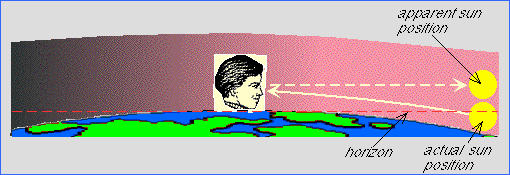


0 Comments